
 English
 中文简体
中文简体
Which Dredging Equipment Technology Delivers the Best Results?
Content
- 1 Cutter Suction Dredgers: High-Efficiency Excavation Enhanced by 2026 Automation
- 2 Trailing Suction Hopper Dredgers: The 2026 Autonomous Workhorse for Waterway Maintenance
- 3 2026 Market Dynamics and Regional Growth Patterns
- 4 Technical Comparison and 2026 Equipment Selection Strategy
- 5 2026 Environmental Compliance and Sustainable Dredging Innovations
- 6 Technological Evolution and Future Trends Beyond 2026
Dredging equipment is the core machinery for modern waterway maintenance, port construction, and hydraulic engineering. In 2026, the global dredging market has reached USD 12.11 billion, with cutter suction dredgers and trailing suction hopper dredgers leveraging autonomous systems, hybrid propulsion, and AI-driven sediment monitoring to become indispensable mainstays in global dredging projects. Cutter suction dredgers excel in hard geology and long-distance discharge scenarios, with unit operating costs 40%-60% lower than traditional methods. Trailing suction hopper dredgers, now equipped with Royal IHC's Mission Master assisted autonomy systems certified at Bureau Veritas automation level A2, independently complete the entire excavation, loading, transport, and dumping process at maximum operating depths of 50 meters, making them the absolute workhorse of modern waterway maintenance.
Cutter Suction Dredgers: High-Efficiency Excavation Enhanced by 2026 Automation
Core Working Principle and 2026 Innovations
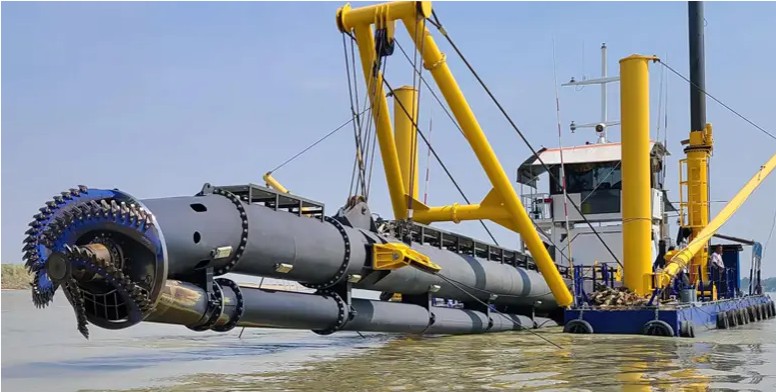
Cutter suction dredgers employ a unique combined operating principle of "mechanical cutting + hydraulic conveying." The auger system at the front of the equipment is driven by a high-power motor and equipped with high-hardness alloy cutters, allowing for adjustable speed and torque to suit varying geological conditions. As the auger rotates and breaks up the soil, a powerful centrifugal pump generates strong negative pressure that draws the crushed material out through a pipeline. The entire system is coordinated by a sophisticated positioning control system, with DGPS positioning ensuring planar accuracy of ±10 cm and an automatic traverse system precisely controlling the operating range.
In 2026, cutter suction dredgers have undergone significant technological leaps. Electric cutter suction dredgers introduced in recent years offer a 28% improvement in energy consumption compared to diesel variants. Royal IHC's decade-long research has produced the innovative Curve Tooth cutter head, featuring biomimetic curved teeth that remain sharper throughout their lifespan, reduce spillage by up to 30%, and enable single-person replacement through a hammerless locking mechanism. The new tooth design is over 10% lighter than competitors while maintaining larger cutting and wear volumes, directly improving fuel efficiency and handling safety .
Technical Advantages and Engineering Performance
Cutter suction dredgers have demonstrated exceptional ability to handle complex geology in major projects such as the Yangtze River Estuary Deepwater Channel Regulation, effectively managing geological conditions ranging from soft silt to hard weathered rock. Their standout characteristics include:
- Transport excavated material directly to storage areas several kilometers away via pipelines, achieving integrated excavation and transportation operations
- Support 24-hour continuous operation with equipment utilization rates exceeding 85%
- Unit operating costs are 40%-60% lower than traditional processes, delivering significant economic advantages
- Diffusion of suspended solids reduced by 70% and noise pollution reduced by 50%, aligning with modern environmental protection requirements
Smart Operations Through Digital Twin and AI Integration
By 2026, cutter suction dredgers have evolved into intelligent, data-driven systems. Digital twin technology creates virtual reproductions of actual dredging systems, enabling operators to evaluate scenarios and optimize equipment settings without disrupting workflows. Machine learning algorithms allow dredging systems to learn from previous operations and automatically adjust settings to increase production while decreasing equipment wear. Real-time 3D seabed mapping platforms were used in over 200 operations across Asia and the U.S. in 2023, enabling highly targeted dredging, while AI-powered depth adjustment tools introduced to 76 large projects improved sediment efficiency by 31%.
Trailing Suction Hopper Dredgers: The 2026 Autonomous Workhorse for Waterway Maintenance
Integrated Operational Workflow and Autonomous Capabilities
Trailing suction hopper dredgers lower their raking head to the seabed via raking arms on either side of the hull. High-pressure water jets on the raking head loosen the bottom, while a centrifugal pump generates powerful negative pressure that draws the slurry into the vessel's hold through pipes. Once fully loaded, the vessel self-propels to the dumping area, where material is discharged via bow jetting or bottom unloading. An automatic draft control system precisely adjusts the dredging depth, and modern trailing suction hopper dredgers equipped with advanced control systems achieve centimeter-level dredging accuracy.
In 2026, autonomous dredging has become a defining trend. Royal IHC's Mission Master system, launched in 2025 and now widely deployed, provides assisted autonomous control for hopper dredgers operating at Bureau Veritas automation level A2. This facilitates semi-autonomous vessel operation with human oversight, improving operational efficiency and offsetting skilled crew shortfalls. The Dutra Group's newbuild vessel ADELE, constructed by Eastern Shipbuilding Group and completed in 2026, features IHC's latest advancements in pump technology, Mission Master human-initiated autonomous dredging/sailing, and condition monitoring systems, representing the cutting edge of autonomous trailing suction hopper dredger design.
Operational Scope and Capabilities
As the absolute workhorse of waterway maintenance, trailing suction hopper dredgers possess unique self-propulsion capability to independently complete the entire excavation, loading, transport, and dumping process. Their technical parameters and applicable scenarios are as follows:
| Performance Indicator | Parameter Range | Engineering Significance |
|---|---|---|
| Maximum Operating Depth | 50 meters | Covers the vast majority of waterway and port areas |
| Dredging Accuracy | Centimeter-level | Ensures precision in waterway maintenance operations |
| Applicable Bottom Conditions | Soft silt to dense sand | Adapts to diverse waterway maintenance requirements |
| Operating Mode | Self-propelled full-process | No auxiliary vessels required; completes operations independently |
| Autonomy Level | Bureau Veritas A2 | Semi-autonomous with human oversight via Mission Master |
| Propulsion Innovation | Hybrid propulsion available | DEME's Lucien Kimpe features advanced fuel efficiency for low-emission operations |
2026 Market Dynamics and Regional Growth Patterns
The global dredging market is projected to grow at a 2.1% CAGR from 2026 to 2036, driven by infrastructure expansion, coastal resilience initiatives, and port modernization to accommodate mega vessels. Regional growth varies significantly:
| Region | Projected CAGR | Key Growth Drivers |
|---|---|---|
| Germany | 3.8% | North Sea and Baltic Sea port competitiveness; flood protection systems |
| India | Steady growth | Long coastline and maritime expansion; inland waterway upgrades |
| France | 2.1% | Port modernization and environmental compliance initiatives |
| Asia-Pacific | Fastest growth | New market entrants offering competitive technology; large-scale reclamation projects |
The market remains highly specialized, with technical expertise and fleet capability forming key competitive differentiators. Major industry participants include DEME, Hyundai E&C, Great Lakes Dredge & Dock, TOA Corporation, and Royal IHC, all competing through advanced fleet modernization and environmentally responsible dredging techniques.
Technical Comparison and 2026 Equipment Selection Strategy
In actual engineering projects, the selection between cutter suction and trailing suction hopper dredgers requires comprehensive consideration of geological conditions, operating distance, environmental requirements, and economic factors. The core differences between the two are as follows:
| Comparison Dimension | Cutter Suction Dredger | Trailing Suction Hopper Dredger |
|---|---|---|
| Positioning | Spud/anchor positioning, DGPS accuracy ±10 cm | Self-propelled, dynamic centimeter-level accuracy; Mission Master autonomy |
| Discharge Distance | Several kilometers via pipeline | Self-propelled to designated dumping area |
| Applicable Geology | Soft silt to hard weathered rock | Soft silt to dense sand |
| 2026 Energy Innovation | Electric variants with 28% better energy efficiency; Liebherr e8300 electric duty cycle dredge | Hybrid propulsion systems; DEME Lucien Kimpe low-emission operations |
| Cost Advantage | Unit cost reduced by 40%-60% | Reduced dependency on auxiliary vessels; autonomous operation offsets crew shortages |
| Environmental Performance | Suspended solids reduced by 70%, noise lowered by 50%; Curve Tooth reduces spillage 30% | Controlled discharge via bow jetting/bottom unloading; integrated silt curtains |
| Typical Applications | Port infrastructure, reclamation, mining tailings | Waterway maintenance, deepwater dredging, coastal resilience |
Key Selection Decision Points for 2026 Projects
- For projects involving hard rock excavation or requiring long-distance pipeline discharge (such as reclamation), prioritize cutter suction dredgers with 2026 Curve Tooth technology for 30% spillage reduction
- For projects focused on waterway maintenance with dispersed operating areas and frequent relocation needs, trailing suction hopper dredgers with Mission Master autonomy are optimal, addressing skilled crew shortages while improving accuracy
- In environmentally sensitive areas, electric cutter suction dredgers offer 28% energy improvement and reduced emissions, while over 240 vessels now feature onboard sediment testing laboratories for real-time toxicity evaluation
- For deepwater operations (approaching or exceeding 50 meters depth), trailing suction hopper dredgers with hybrid propulsion represent the more feasible technical solution, aligning with 2026 low-emission mandates
- When crew availability is constrained, autonomous systems reduce on-site personnel needs by up to 40%, making automation-equipped dredgers increasingly cost-effective
2026 Environmental Compliance and Sustainable Dredging Innovations
Environmental sustainability has become the central focus of dredging equipment development in 2026. The industry has shifted toward low-emission and hybrid dredging fleets, with beneficial reuse of dredged materials gaining traction as a standard practice. Precision dredging technologies using sonar mapping and GPS-enabled automation systems minimize over-excavation and ecological disruption.
Key 2026 environmental innovations include:
- Onboard sediment testing laboratories: Over 240 vessels now equipped, allowing operators to evaluate toxicity levels and avoid ecological damage, leading to over 3,500 projects meeting new ISO environmental standards in 2023
- Integrated silt curtains and turbidity control systems: Standard on modern vessels to prevent sediment plume dispersion
- Beneficial reuse programs: Dredged materials increasingly repurposed for land reclamation, wetland restoration, and construction aggregate, reducing disposal requirements
- Carbon-neutral equipment development: Manufacturers investing in electric and hybrid systems to meet evolving emissions regulations
- AI sediment monitoring: Real-time sensors continuously monitor turbidity, fuel efficiency, and emissions, enabling immediate corrective actions when parameters exceed thresholds
Technological Evolution and Future Trends Beyond 2026
Modern dredging equipment is continuously evolving toward greater intelligence, environmental sustainability, and operational autonomy. Predictive maintenance using IoT sensors now tracks temperature, pressure, and vibration changes in pumps, cutterheads, and hydraulic systems, reducing unexpected equipment failure by up to 19% year-over-year. Maintenance forecasting tools analyze performance data to detect potential failures before they occur.
Collaborative robotics (cobots) are being deployed alongside human operators to improve safety and efficiency, assisting with hazardous tasks such as equipment inspections and maintenance. Variable Frequency Drives (VFDs) provide real-time control over pump performance, adjusting speed and power consumption based on sediment density to improve efficiency while reducing energy usage.
Looking beyond 2026, the industry anticipates fully autonomous dredging systems operating at higher Bureau Veritas automation levels, complete electrification of harbor and inland dredging fleets, and digital twin integration enabling shore-based remote operation of entire dredging fleets. As governments balance economic competitiveness with environmental sustainability, companies capable of delivering precision dredging solutions within strict regulatory frameworks will secure long-term contracts in this mission-critical industry tied to global trade continuity and climate adaptation strategies.

Copyright 2025 Taizhou Sanyang Heavy Machinery Co., Ltd. All Rights Reserved Professional Dredging Equipment Manufacturer

Back To Top