
 English
 中文简体
中文简体
Cone Crusher Maintenance Tips: Daily Checks, Liners, and Lube Intervals
Content
- 1 Every Shift: Five Readings Worth Writing Down
- 2 Feed Control Is the Cheapest Maintenance You Will Ever Do
- 3 Liners, Closed Side Setting and Chamber Shape
- 4 Lubrication: Oil Temperature, Cleanliness and Filters
- 5 Where Unscheduled Downtime Usually Comes From
- 6 A Maintenance Schedule That Actually Gets Followed
- 7 Five Mistakes That Shorten Crusher Life
- 8 Frequently Asked Questions
- 9 The Habit That Matters Most
A worn bowl liner is rarely the first thing to go wrong on a cone crusher. By the time the wear pattern becomes visible, the real cause has usually been running for months: an off-center feed from the haul trucks, a return oil temperature that crept past its limit, or a closed side setting that was adjusted to chase a product curve instead of a load reading.
The short version of cone crusher maintenance is this: keep the feed centered and choke-fed, hold the closed side setting inside its tolerance band, keep the lubricating oil clean and cool, log the same five readings every shift, and replace wear parts on measured wear rather than on a calendar. Everything else is detail, and the detail is what the sections below lay out.
Every Shift: Five Readings Worth Writing Down
Most cone crusher failures announce themselves weeks before they stop production. The trouble is that the warning arrives as a small movement in a number nobody recorded yesterday, so it looks like noise instead of a trend.
A single shift log with five entries covers the majority of failure modes:
- Main motor current – the fastest available indicator of crusher load.
- Lubrication return oil temperature – the fastest indicator of bearing distress.
- Lube system pressure – a sudden change usually means a blocked filter or a failing pump.
- Vibration at the adjustment ring – the earliest sign of an unbalanced or eccentric load.
- Closed side setting (CSS) – measured at the end of the shift, not once a month.
Treat the figures in the table below as a starting reference and replace them with the values your manufacturer specifies for your model. Then set the alarm point roughly 10 to 15 percent beyond the normal band, so there is still time to react instead of time to shut down.
| Reading | Normal working band | Stop-and-inspect trigger | How to measure |
|---|---|---|---|
| Main motor current | Stable, averaging below nameplate rating | More than 8 percent above its own baseline for two consecutive shifts | Control cabinet ammeter |
| Lube return oil temperature | 38 to 50 degrees Celsius | Above 55 degrees Celsius, or a 10 degree rise in 30 minutes | Oil tank thermometer |
| Lube system pressure | Steady within the manufacturer window | Fluctuation wider than 0.05 MPa, or a sudden drop | Panel pressure gauge |
| Vibration at adjustment ring | Flat baseline on the same mounting point | Any rise of 20 percent or more against the baseline | Portable vibration meter |
| Closed side setting | Within plus or minus 2 mm of target | Drift of 5 mm or more | Lead shot or ultrasonic gauge |
Feed Control Is the Cheapest Maintenance You Will Ever Do
Nothing on a cone crusher wears out faster than a machine fed from one side. When material lands on a single point of the bowl, the crushing force concentrates on one sector of the mantle and liners, the main shaft is pushed off axis, and current draw becomes uneven. The liners in that sector can wear two to three times faster than the rest of the ring.
The fix costs nothing but discipline:
- Feed around the full 360 degrees. A rotating or oscillating feed distributor is the standard solution, and it pays for itself within one liner set on most installations.
- Run choke-fed whenever the circuit allows. A chamber that stays full absorbs impact energy through the material bed instead of through the liners, and it produces a far more consistent product shape.
- Respect the maximum feed size. Oversize lumps do not break; they bend the main shaft, hammer the liners, and spike the motor current.
- Screen before you crush. Fines that bypass the screen and enter the chamber pack the cavity, raise the power draw, and reduce throughput without producing any useful product.
If the motor current swings by more than a few percent during a steady production run, look at the feed arrangement before you look at the crusher.
Liners, Closed Side Setting and Chamber Shape
Manganese liners work-harden as they wear, which means a new set is soft during its first 100 hours or so. That break-in period is when most of the initial distortion happens, so a CSS that measures perfectly on day one can be several millimeters off by the end of the first week.
Three habits keep the chamber under control:
- Measure the CSS after every shift for the first week of a new liner set, then move to a weekly schedule once the wear rate settles.
- Inspect rather than guess. A liner with uneven wear, cracks at the mounting edge, or a remaining thickness below the manufacturer's scrap limit should be pulled even if it still crushes.
- Watch the product curve, not just the tonnage. As the chamber geometry changes, the finished gradation shifts toward the coarse end, and the fine fraction drops away. A sudden jump in oversize returns usually means the chamber profile has gone out of shape.
Uneven wear is the single most common reason a liner set fails early, and it is almost always a feeding or CSS problem rather than a metallurgy problem. If you are specifying a new machine for a quarry or aggregate circuit, our 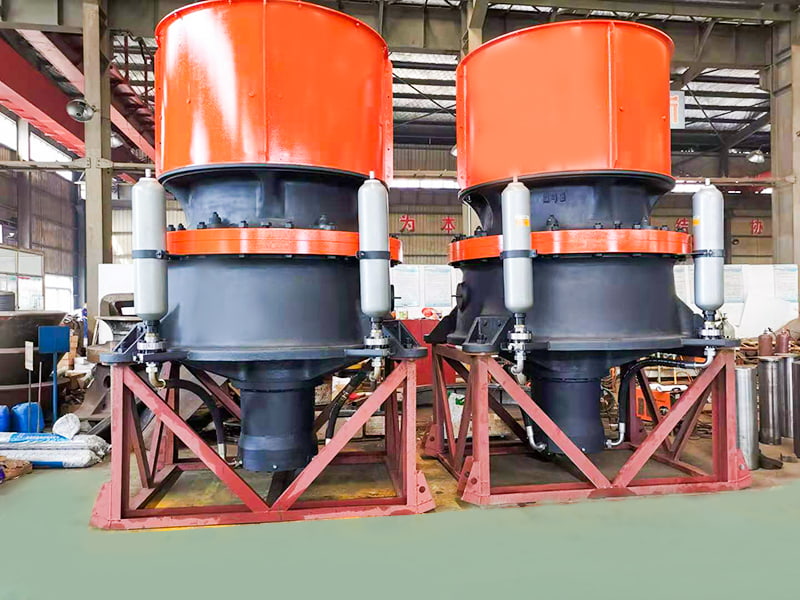 Cone Crusher with Hydraulic Adjustment for Secondary and Tertiary CrushingA cone crusher using laminated crushing in an annular chamber to produce cubic material from hard ores, with hydraulic discharge adjustment and over-tramp protection. Relevant when liner wear, feed setup, and lubrication reliability matter.View Product → range is built around chambers that hold their profile across long production runs, and the wear parts are matched to the same baseline geometry.
Lubrication: Oil Temperature, Cleanliness and Filters
The lubrication circuit is the circulatory system of the crusher, and nearly every catastrophic bearing failure starts with something small in the oil: a filter that was not changed on time, a breather that let quarry dust into the tank, or an oil that never reached viscosity grade.
Work to these principles:
- Change the filter element on the interval in the manual, not when it clogs. A pressure differential across the filter is already a symptom, and by then the bypass is passing contaminated oil to the bearings.
- Keep the tank sealed. Check the breather and the air filter on the tank; an open path between dust and oil will defeat every other maintenance effort.
- Warm up before loading. In cold conditions, circulate oil until it reaches the minimum operating viscosity. Starting a crusher under load with cold oil is one of the few ways to destroy a bearing in a single shift.
- Sample the oil regularly. Particle counts and wear metal readings tell you what a temperature gauge cannot, and they cost a fraction of a bearing set.
On water and dust ingress, the dust seal ring and the packing around the bowl are consumables. Worn sealing surfaces let abrasive slurry into the eccentric assembly, and the resulting damage shows up much later as vibration and high oil temperature.
Where Unscheduled Downtime Usually Comes From
The failure causes below are not equally distributed. In most plants, feeding practice and chamber condition account for well over half of all unplanned stops, which is why the earlier sections of this article focus on them.
- Uneven feed or chamber packing – 30%
- Liner and CSS mismanagement – 25%
- Oil contamination or overheating – 20%
- Hydraulic and clearing faults – 15%
- Bolts, seals and other causes – 10%
The practical conclusion is that four out of five unplanned stops are traceable to things a shift team can influence without replacing a single major component.
A Maintenance Schedule That Actually Gets Followed
The schedule below is written for a machine running two shifts a day. Compress or extend it according to tonnage and dust conditions, but keep the order of operations intact, because checks that depend on a warm machine must happen before the shutdown cleaning starts.
- Every shift: record current, oil temperature, oil pressure, vibration and CSS; listen for unusual noise at the eccentric; confirm the feed is centered.
- Weekly: inspect the discharge belt for tramp metal and liner fragments; check the clamping bolts and the adjustment ring locking cylinders for correct pressure; clean the oil breather.
- Monthly: take an oil sample; inspect liner thickness around the full circumference; verify the hydraulic accumulator pre-charge; check the dust seal for ingress.
- Quarterly: examine the socket liner, eccentric bushing clearance and gear backlash; replace filter elements; verify the calibration of temperature and pressure instruments.
- Annually or at liner change: inspect the main shaft, thrust bearing and frame for cracks; check the foundation bolts and the grouting; renew all seals disturbed during the job.
Any task that cannot be scheduled into a production stop will not be done. Build the quarterly inspection into a planned liner change instead of waiting for a convenient window that never arrives.
Five Mistakes That Shorten Crusher Life
- Adjusting the CSS to fix a product problem. Change the chamber or the screen first; the setting is a load parameter, not a gradation dial.
- Running a starved chamber to save power. A partially filled cavity transfers impact directly into the liners and the main shaft.
- Changing liners one at a time. Mixing a new liner with a worn one distorts the chamber profile and produces off-spec product.
- Ignoring a slow temperature rise. A 5 degree drift over two weeks is a bearing telling you something, not a warm afternoon.
- Buying wear parts on price alone. Manganese grade, profile accuracy and mounting dimensions decide whether a liner lasts 900 hours or 2,500.
Taizhou Sanyang Heavy Machinery is a non-standard heavy machinery manufacturer working across dredging equipment, marine shaft and rudder systems, pile driving hydraulic clamps and mining machinery. The same fabrication and inspection discipline that applies to those products applies to crusher wear parts: the company profile describes the manufacturing and testing capability behind each order.
Frequently Asked Questions
How often should the closed side setting be checked?
After every shift during the first week of a new liner set, then weekly once the wear rate stabilizes. Any time the product gradation changes, measure the setting before touching anything else.
What oil temperature is too high for a cone crusher?
Many machines run comfortably between 38 and 50 degrees Celsius. Sustained operation above 55 degrees, or a rapid rise within a single shift, points to a bearing, a blocked cooler or a filter that is bypassing.
How do I know when a liner needs replacing?
Measure remaining thickness at several points around the circumference and compare against the manufacturer's scrap limit. Uneven wear, edge cracking or a distorted chamber profile justifies replacement before the thickness limit is reached.
Can a cone crusher run without choke feeding?
It can, in some secondary and tertiary circuits, but throughput per kilowatt falls and liner wear becomes less predictable. Where the circuit allows it, a full chamber delivers better shape and longer liner life.
The Habit That Matters Most
Cone crusher maintenance is not a list of repairs. It is a short list of measurements taken consistently enough that a trend becomes visible before it becomes a breakdown. Pick the five readings, write them down every shift, and set the trigger points now rather than after the next unplanned stop.
If you would like a maintenance checklist built around your specific machine, duty cycle and feed material, our engineering team can put one together with the wear part references that match your chamber.

Copyright 2025 Taizhou Sanyang Heavy Machinery Co., Ltd. All Rights Reserved Professional Dredging Equipment Manufacturer

Back To Top