
 English
 中文简体
中文简体
Dredger Gantry Function and Design: Load Paths on a TSHD Drag Arm Explained
Content
A drag arm on a mid-size trailing suction hopper dredger can weigh 40 tonnes dry, and considerably more when the pipe is full of water and the draghead is loaded with clay. Every tonne of that passes through the gantry when the arm is hoisted to the trail position, and a share of it passes through on every movement in between. The gantry, in short, is the structure that carries, guides and controls the drag arm, and it is the hard point where the hull, the winches, the side wires and the suction pipe all meet.
Gantry problems are therefore rarely isolated. Extra flex shows up as uneven wear on the side wire blocks; a pin bore a degree out of alignment shows up as a pipe that hangs out of plane and a turning gland that weeps slurry; a foundation weld never sized for high-cycle fatigue shows up as a crack after two or three seasons. The sections below cover what the gantry does, how designers size the steel and the bearings, which tolerances decide whether a replacement structure pins up cleanly at the shipyard, and what to prepare before ordering.
What the Gantry Actually Does on a Hopper Dredger
The gantry sits at the ship's side, spans over the drag pipe and is usually a welded portal with two legs landing on deck stools or a dedicated foundation. It has five jobs, and a structure that does four of them well will still fail in service.
- Carrying the drag arm in the raised, trail or harbour position, with the draghead end in a cradle, so the gantry takes the pipe's bending moment plus amplification from ship motion.
- Guiding the arm while it is lowered and hoisted: keeping the pipe in its working plane and clear of the shell plating, and resisting athwartship swing caused by roll.
- Anchoring the rope system, including gantry sheaves, sheave pins, side wire blocks, rope guides and the winch lead-in. Rope geometry is decided here, and rope wear further downstream is often the price of a poor sheave layout.
- Supporting the pipe-end connections: the turning gland that lets the pipe rotate about its own axis, and the cardanic joint that absorbs angular deflection as the draghead follows the seabed.
- Stiffening the ship's side locally, because gantry reactions land on stools, brackets and shell stiffeners that normally sit in the same scope of supply.
On a cutter suction dredger, the ladder gantry does a comparable job for a very different machine, so component names overlap while load cases do not. If you are comparing the two families, it helps to start with the full range of trailing suction hopper dredger components, which groups pipe, draghead, gland and hopper-side items by function rather than by drawing number.
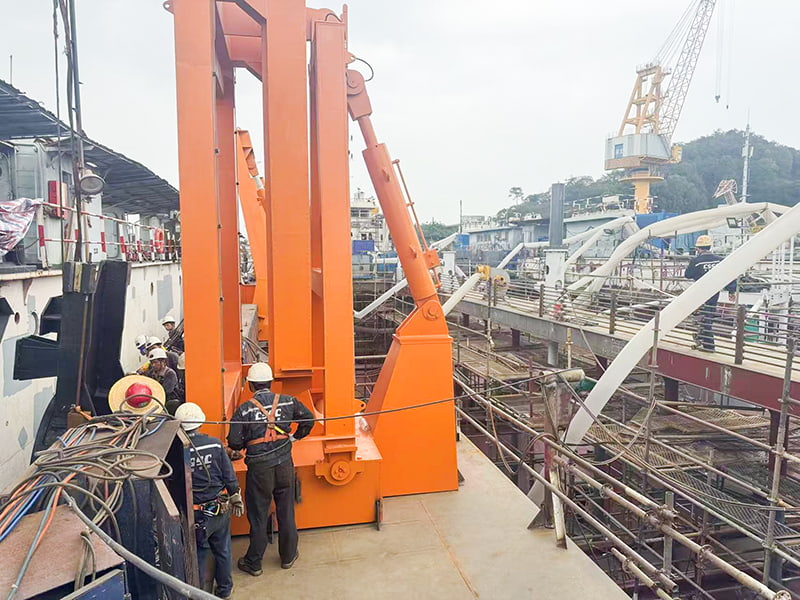 Gantry for Trailing Suction Hopper Dredger ComponentsKey load-bearing gantry connecting hull to hopper head; supports 50–300 ton mechanism, positioning, depth control, dynamic impact absorption, and service routing.View Product →
Design Logic: Loads, Steel and Bearings
Load cases that drive the steel
Static weight is only the starting point. Gantry design loads combine pipe and draghead weight, entrained soil, a dynamic amplification factor of roughly 1.3 to 2.0 depending on class rule and sea state, the winch break-out load when a draghead is stuck, and shock from hard material. Fatigue deserves more attention than it usually gets: the pipe stays in the water for weeks at a time, so the structure is loaded by continuous small-amplitude wave motion rather than by a few lifts a day. That is high-cycle fatigue, and it is why the weld details at the base and around the sheave brackets matter far more than a generous factor on yield.
Structure and material selection
Most gantries at this scale are welded box or plate girders in higher-strength hull grades such as DH36 or EH36, or an S355 equivalent, chosen for section modulus without giving up toughness in the splash zone. Two fabrication habits separate a structure that pins up cleanly from one that does not: machining pads and pin bores after welding, and controlling distortion with a weld sequence that balances volume on both sides of the section.
Bearings, sheaves and pipe-end hardware
Hinge and gudgeon pins usually run in bronze bushings with grease or sealed lubrication, bores machined to an H7 fit and pins to h6. Sheave groove radius should match the actual rope diameter rather than the nominal one, and the sheave-to-rope diameter ratio is normally kept at twelve to sixteen or above so bending stress in the wire stays reasonable. A drag arm is rarely rigid either: a swell compensator holds tension and pipe angle within a narrow band while the ship moves in a seaway, and the gland and cardanic joint absorb the remaining rotation.
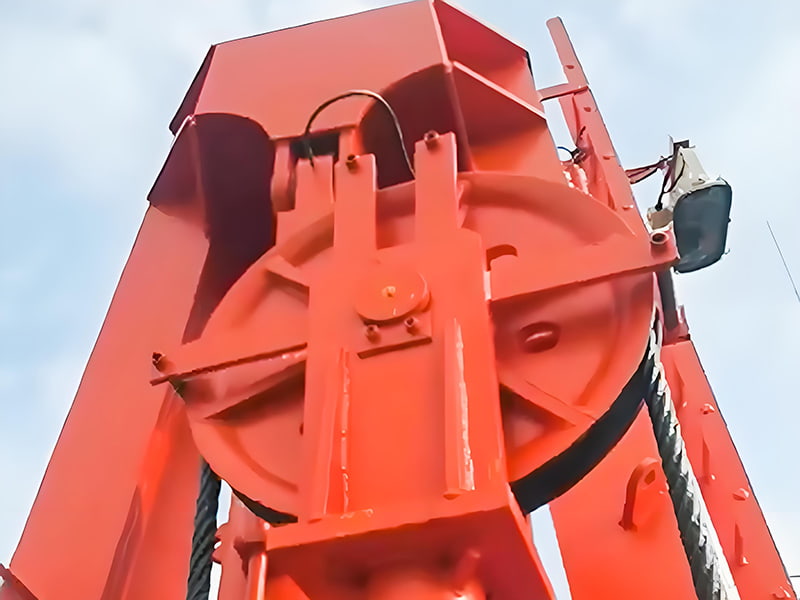 Swell Compensator for Trailing Suction Hopper Dredger SystemsSwell compensator providing real-time heave compensation, stabilizing draghead ground pressure within ±5%, and cutting dynamic shock loads by 60–80%.View Product →
Tolerances and Interface Control: Where Gantries Really Fail
Retrofit work is where gantry projects go wrong, usually for dimensional rather than metallurgical reasons. The hull was not built to the same datum as the new structure, the deck stools have probably been repaired at some point, and nobody measured the twist in the ship's side. The table below lists the parameters worth fixing in the interface control document before fabrication starts.
| Parameter | Typical target | What it prevents |
|---|---|---|
| Bushing bore fit (hinge pin) | H7 bore, h6 pin, 0.10-0.30 mm diametral clearance | Pin seizure at working temperature, or impact loading from a slack joint |
| Sheave axis alignment | Within 0.5-1.0 mm per metre across the sheave | Rope riding the flange, side wear and premature wire replacement |
| Mounting pad flatness | 0.10-0.20 mm on the machined contact face | Point loading, gap corrosion and cracking of the foundation weld |
| Hole position over a pad group | Plus or minus 1.0-2.0 mm | Shimming at the shipyard, elongated holes and a lost installation window |
| Structural steel grade | DH36, EH36 or S355 equivalent | Brittle behaviour at low temperature and in the splash zone |
| Design factors | 1.3-1.5 on static load, shock factor up to 2.0 | Under-sized pins, brackets and rope terminations |
Two entries repay attention more than the rest. Hole position first: a gantry that needs 4 mm of shim on one stool is a conversation with the class surveyor, while one drilled to a measured survey is not. Pad flatness second: a pad that is flat on the drawing but dished in the workshop will be pulled straight by the bolts and pre-load the weld beneath it. Acceptance testing follows the same logic, with a proof load on winch and gantry at 1.25 times rated load, a trial assembly of the pin joints before painting, and a dimensional report issued with the structure.
Service Life: Wear Parts and the Dredging Cycle
A gantry is a fixed structure, but everything it carries is consumable. Budget maintenance around four items.
- Side wire blocks and rope: sheave wear is quiet and progressive, so check for rope flattening and broken wires at the same interval you use for the draghead.
- Sheave liners: replace them when the groove radius opens beyond the rope maker's limit, not when the liner looks thin.
- Pins and bushings: measure clearance at every docking, because a joint that has gone from a light interference fit to visible play has already changed the pipe's working angle.
- Coating and anodes: the splash zone is where a gantry dies first.
Inspection intervals should follow the dredging cycle rather than the calendar. A vessel dredging abrasive sand for 6,000 hours a year will show wear far earlier than one working soft silt for a single campaign. Recording pipe angle, wire tension and pin clearance after each drydock gives you the trend line that turns an inspection into a decision.
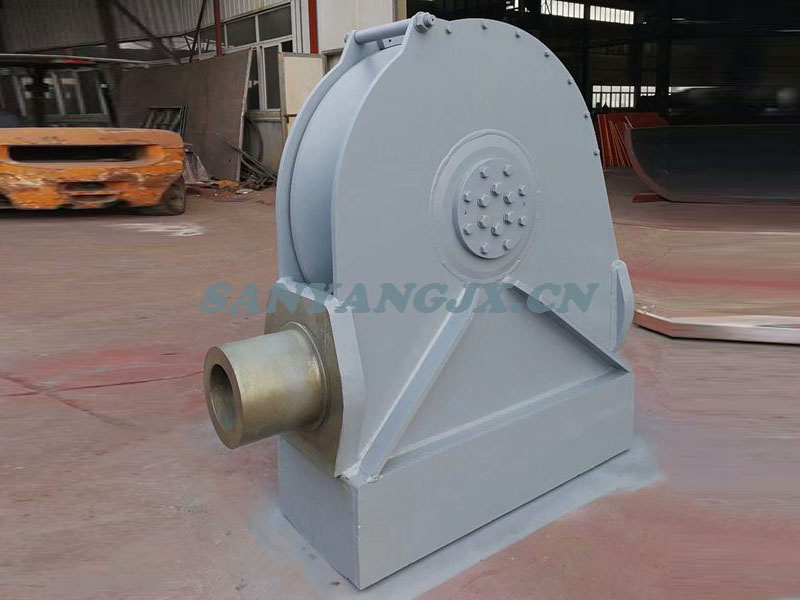 Horizontal Sliding Pulley for Cutter Suction DredgerCable guiding and load-bearing pulley for cutter suction dredger lateral sliding and swinging, reducing cable wear while carrying traction loads.View Product →
Procurement and Retrofit: What to Send a Manufacturer
A non-standard gantry is designed against your hull, not chosen from a catalogue, so the input package decides the schedule. The minimum that keeps a shop from making assumptions is:
- A dimensional survey of the deck stools, covering flatness, hole pitch, elevation and any welded repairs.
- The operating envelope: maximum pipe angle, trail position, winch break-out load and design sea state for transit.
- Interface loads from the pipe supplier, plus pipe weight and centre of gravity if the pipe is being replaced.
- Class and flag requirements to be met, and who owns the approval correspondence.
- Transport constraints, lifting lug positions and the NDT extent you expect on the main connections.
Ask for a trial assembly of the pin joints before shipment, and for the dimensional report to travel with the structure. Where a new draghead, bend or gland is delivered alongside the gantry, one survey should cover both items, because the interface is shared; grouping them into a single shipment, as happens with deliveries of drag head and drag arm parts, keeps that documentation in one place.
FAQ
Can a gantry be repaired in place instead of replaced?
Often, yes. Local renewal of a leg, gusset or sheave bracket is normal, provided the repair welding follows a qualified procedure and pin bore alignment is re-checked afterwards. Replacement is usually driven by distortion in the main section or by corrosion below the original allowance, not by a single crack.
Fixed gantry or slewing structure?
Fixed gantries are simpler, stiffer and cheaper to maintain. A slewing structure earns its place when the pipe must be stowed clear of the side for long transits, or when the deck arrangement leaves no room for a fixed portal. Confirm that the operating profile really needs that extra degree of freedom before paying for the slewing ring and its locking arrangement.
What drives the price of a replacement gantry most?
Machining and alignment, not raw steel. Post-weld machining of pads and bores, trial assembly and dimensional reporting typically cost more than the difference between a standard and a higher-strength grade. Cutting those steps to save money simply moves the cost into the shipyard period, where it is far harder to absorb.
The gantry is the least glamorous item in a dredging equipment package and one of the few whose failure stops the vessel outright. Size it from the real operating envelope, machine the interfaces after welding, measure the hull before cutting steel, and treat the sheaves, ropes and pins as the consumables they are. Do that and the structure stays where it belongs: in the background, holding a drag arm steady over the side of the ship.

Copyright 2025 Taizhou Sanyang Heavy Machinery Co., Ltd. All Rights Reserved Professional Dredging Equipment Manufacturer

Back To Top