
 English
 中文简体

Hatch Cover Types for Cargo Ships: Folding, Rolling, Pontoon and Roll-Stowing
Content
- 1 The five cover types at a glance
- 2 Folding covers: the working default on bulk carriers
- 3 Side-rolling and end-rolling covers: rails instead of hinges
- 4 Lift-away pontoon covers: no hydraulics, more crane time
- 5 Roll-stowing and sliding covers: compact stow, more mechanism
- 6 How to settle the specification: five questions
- 7 Where the cover meets the coaming
- 8 Frequently asked questions
A water-ingress claim on a handysize bulker rarely starts with a defective steel plate. It usually starts three years earlier, when someone specified a cover type that suited the previous ship rather than this one: a folding set on a trade where the crew must work six hatches twice a day from a single hydraulic power pack, or lift-away pontoons where the shore crane is booked for four hours and the covers eat two of them.
The short answer, before the detail: choose the cover by cargo, discharge method, hatch geometry and the deck space you can afford to give up. Panel material, packing rubber, cleats and drive arrangement then follow from those four. What follows covers the five families that fit almost every cargo ship, what each one costs in daily operation, and the details that decide whether a cover is still weathertight after five years of grabs, salt and hull flexing.
The five cover types at a glance
Nearly every general cargo and bulk vessel in service uses one of these arrangements. The trade-offs are structural, not cosmetic: a type that opens in two minutes can still be the wrong choice if it takes the deck space your cranes need.
| Cover type | How it opens and stows | Typical ships | Main strength | Operating penalty |
|---|---|---|---|---|
| Folding | Hinged panels fold back and stack at one end of the hatch | Bulk carriers, handysize to capesize | Fast cycle, clear opening for grabs | Hydraulic cylinders and hinges to maintain; pack blocks crane reach |
| Side-rolling | Panels run on rails along the ship's side | Bulk carriers, ore carriers, wide hatches | Nothing stands above the open hatch | Permanent deck strip lost; track and wheel alignment critical |
| End-rolling | Panels run fore-and-aft on rails | Narrower bulkers, coasters, barges | Fits narrow decks | Long travel; stack height at the hatch end |
| Lift-away pontoon | Individual panels lifted on and off by crane | Container ships, multipurpose, heavy cargo | No hydraulics; container fittings possible | Depends on crane availability; stack and lashing discipline |
| Roll-stowing / sliding | Panels slide, then lift and stack vertically at the end | Smaller bulk carriers, self-unloaders | Compact footprint on deck | Complex guides and rams; tight vertical clearance |
Folding covers: the working default on bulk carriers
Folding covers dominate dry bulk because they solve the two problems that matter at the berth: clearance and time. Two to four panels per side are hinged together; hydraulic cylinders lift the leading panel, the trailing panels fold onto it, and the pack then travels to a stow position at one end of the hatch. A 20 m hatch opens fully in around two minutes on a healthy system, which is why the type survives on ships where every other fitting has been rethought.
The stow position is where design choices start to bite. The folded pack stands above the coaming at one end, so the operator loses reach on that side and the stack interrupts the line of sight for a grab working the far end. On long hatches, piggyback arrangements stack panels in two tiers to keep the stow height workable; on short hatches, a single-pull set with two panels per side is usually enough.
In service the failure points are predictable: hinge pins that seize when greasing is skipped, cylinder rods that pit in salt spray, sequence valves that let a panel fold before the locking cleats have released, and packing rubber that hardens into a permanent set. None of these is expensive to fix early, and all of them are expensive to fix once a hold has taken water.
Side-rolling and end-rolling covers: rails instead of hinges
Side-rolling covers
Side-rolling sets keep the panels parallel and run them on rails along the ship's side, driven by hydraulic motors through rack-and-pinion drives. Nothing stands above the hatch when it is open, which suits grab or hopper work over the full length and lets deck cranes reach across without a blind side.
The price is a permanent strip of deck reserved for panels and tracks, plus alignment. Tracks have to stay flat and parallel as the hull works between loaded and ballast conditions, so the drive normally includes a flexible element, and wheels and racks are wear items. Misalignment shows up first as heavy steering on the drive, then as leaks at the panel joints.
End-rolling covers
End-rolling covers use the same principle but travel fore-and-aft and stow at the hatch end. They suit narrower vessels with no room to park panels beside the hatch, and small coasters or barges where a simple arrangement with few panels is easier to maintain. Travel length and stow height are the constraints; on a long hatch the pack can end up tall enough to interfere with crane reach.
Lift-away pontoon covers: no hydraulics, more crane time
Pontoon covers are individual panels lifted on and off by the ship's gear or a shore crane. Container ships use them almost exclusively, often with container foundations and lashing points built into the panel top; multipurpose and heavy-cargo vessels use them because a single panel can be left off or exchanged when an awkward lift demands it.
Where they win and where they cost:
- No power pack, cylinders or sequence valves to maintain, and no rails to keep aligned.
- Panel weight is capped by the crane that must lift it — and that crane is also the one you need for cargo.
- Panels must land squarely on the packing before they are secured; a rushed landing on a distorted coaming is the classic route to a wet hold.
- Stacked panels need lashings and a defined stow plan, or the next port finds them shifted.
Roll-stowing and sliding covers: compact stow, more mechanism
Roll-stowing covers slide along the hatch and then lift and stack vertically at the end through a lift-and-roll mechanism. The footprint is small, which is why the type appears on smaller bulk carriers and self-unloading ships where deck space is tight and hatches are short.
The compromise is mechanical complexity in a confined space: guides, lifting rams and locking arrangements that have to act in the correct order. If the crew routinely overrides a sequence to close the ship before weather arrives, that is a design signal rather than a training problem.
How to settle the specification: five questions
Before panel material or cleat spacing is discussed, answer these in order. They eliminate most of the field on their own.
- How is the cargo discharged? A grab needs clear vertical access and a stow position outside its working area; pneumatic or conveyor discharge tolerates a lower, bulkier pack.
- What does the hatch look like? Length, breadth, coaming height and hatch count decide whether a pack can stow at one end without blocking the next opening.
- Which crane lifts what? If shore cranes handle both cargo and panels, pontoon weight becomes a scheduling constraint, not just a structural one.
- How much deck can be surrendered? Side-rolling covers remove a working strip along the hatch for the life of the ship.
- Which load and class requirements apply? IACS unified requirement S21 sets a 1.75 t/m² design load for bulk carrier covers, with S21A covering other ship types; panel scantlings, hinges and cleats all follow from that figure plus the ship's loading manual.
Answer those five and the type usually picks itself. What remains is detail: panel material, packing profile, drainage and the tolerance chain between coaming, panel and cleat.
Where the cover meets the coaming
A hatch cover is only as weathertight as the flatness of the coaming it lands on. Coaming top plates commonly sit around 600 mm above an exposed deck, and the packing rubber has to compress consistently around the whole perimeter — including the corners, where the drain channel and its non-return valve sit.
Three details decide long-term performance more than the cover type itself:
- Packing compression. Rubber that is over-compressed takes a set; rubber that is under-compressed leaks. Ultrasonic measurement of the panel-to-coaming gap at surveys is a better indicator than a visual check.
- Cleat condition. Quick-acting cleats hold the panel down against the packing, and a bent wedge or a missing cotter changes the load path on its neighbours.
- Galvanic protection. Aluminium panels on steel coamings need separation at every contact point, or corrosion starts at the joint and works outward.
For newbuilds and retrofits alike, the practical route is to have cover, coaming interface and cleat layout drawn as one assembly rather than three. Working from an existing coaming survey, our team can review the drawing set before panels are cut and match hinges, cylinder brackets and cleat positions to the ship as built — send the hatch schedule through to the engineering desk and the interface is settled on paper first.
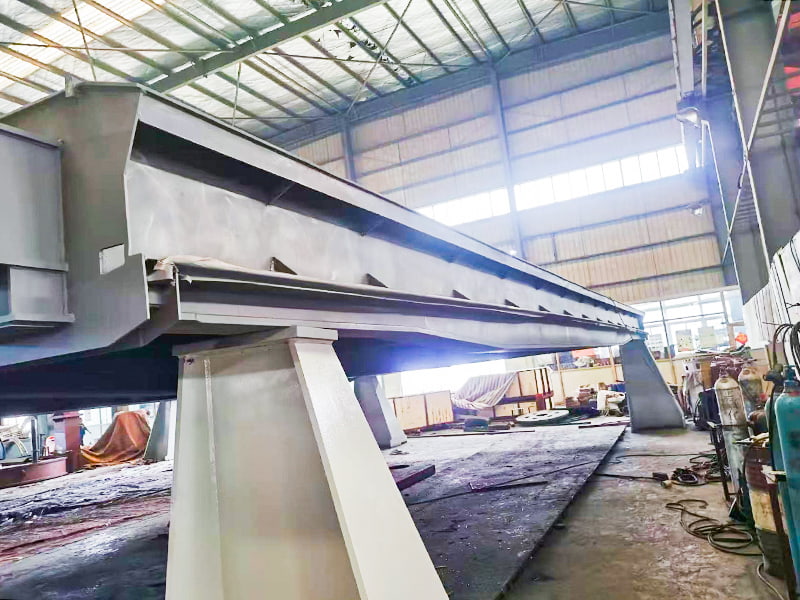 Removable Deck-Opening Hatch Cover for ShipsReview this removable deck-opening hatch cover, relevant to cover, coaming and cleat interface planning, for watertight integrity and cargo protection.View Product →
Frequently asked questions
Are aluminium hatch cover panels always the better choice?
Aluminium alloy panels cut weight, which can add deadweight, but they dent more readily under a grab and need careful steel-to-aluminium separation at hinges and cleats. Steel panels are heavier, tolerate impact better and are easier to repair in a yard with basic welding. The answer follows the cargo and the crew's repair capability.
What is the difference between weathertight and watertight covers?
Cargo hatch covers are weathertight: they keep water out in any sea condition but are not designed to hold a head of water. Watertight is the stronger standard for boundaries that must resist water from either side. The test reflects the difference — weathertightness is verified by hose test at a defined nozzle pressure and distance, or by ultrasonic measurement of packing compression.
Can a ship change hatch cover type during a refit?
Rarely, and not only because of cost. Coaming structure, cleat foundations, hydraulic power and class approval are tied to the original type. Replacing a worn folding set with a new one of the same type is straightforward; converting a hatch to side-rolling means new rails, revised coaming detail and a fresh structural assessment.
How long should packing rubber last?
It depends on cargo, UV exposure and how often the covers work, but a set that is correctly compressed and kept clean will outlast one that is over-compressed or contaminated with grain dust and fertiliser. Inspect at each survey and replace on condition rather than at a fixed age.

Copyright 2025 Taizhou Sanyang Heavy Machinery Co., Ltd. All Rights Reserved Professional Dredging Equipment Manufacturer

Back To Top