
 English
 中文简体

Dredger Winch Types and Applications: How to Match Pull, Duty and Drum
Content
A drag winch that trips on overload twice a shift rarely appears on a dredging report as an equipment fault. It appears as a production shortfall.
The short answer is straightforward: a cutter suction dredger depends on its ladder winch, its two swing winches and its spud winch, while a trailing suction hopper dredger depends on its drag winch pair, the swell compensator and the hopper and gantry winches around them. Anchor, mooring, deck crane and pipe-handling winches support the cycle, but they need the same discipline, because they are the units that fail in port when nothing else can.
In practice, more under-performing dredgers trace back to winch duty, line pull and control settings than to the pump or the cutter head, which makes winch selection a production decision rather than a purchasing formality. The sections below separate winch types by function, then set out the numbers worth fixing before a quotation is placed.
Dredger Winch Types and What Each One Is Doing
Dredger winches are grouped by function rather than by drive. On a cutter suction dredger the ladder winch raises, lowers and holds the ladder at the dredging depth, so its brake must hold the ladder, cutter head and drive assembly without power. The two swing winches pull the ladder left and right around the spud, and because they work as a pair, a mismatch in line speed shows up as a drifting cut.
The spud winch is a different animal: it lifts a spud that may be 25 to 40 metres long and weigh tens of tonnes, at speeds measured in metres per minute, with a mechanical pawl and a brake that holds indefinitely. On a trailing suction hopper dredger the drag winch pair hauls the drag pipe and draghead, where the job is tension control rather than brute force, because the swell compensator keeps the draghead on the bottom while the vessel heaves.
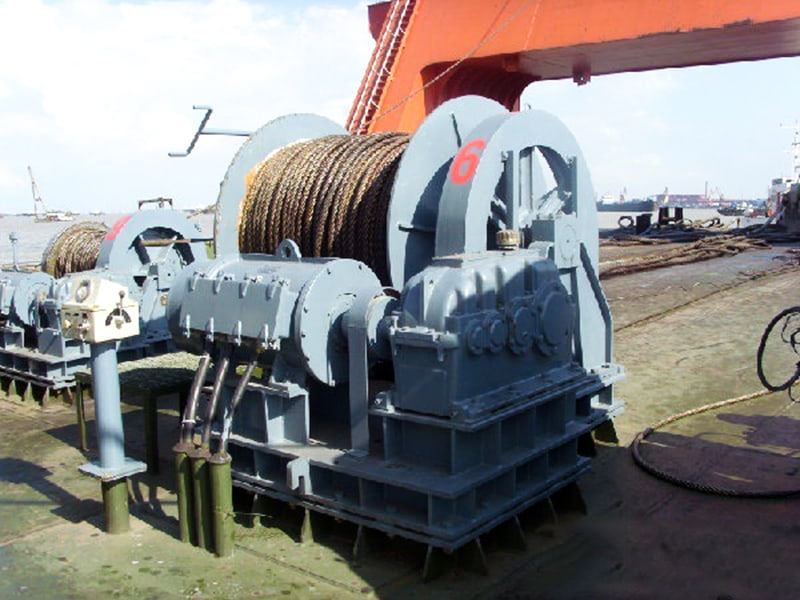 Dredger Winch for Trailing Suction Hopper DredgersMain working winch for trailing suction hopper dredgers, controlling draghead positioning, suction line tension and emergency recovery with 800-1200 kN pulling force.View Product →
Around the production winches sits a long list of auxiliary units, each with its own duty cycle:
- Hopper and bottom-door winches for the discharge and overflow arrangement.
- Gantry winches that lift the drag pipe and its bends during maintenance.
- Anchor and mooring winches for shifting the cut or holding station.
- Deck crane, davit and pipe-handling winches for suction pipes and submersible pumps.
- Heavy hoist winches on grab and backhoe dredgers, with fast lowering and slack-rope protection.
Hydraulic or electric drive?
Both drives are used, and both can be classed. Hydraulic drives tolerate shock loading, produce high torque at low speed and fit into a confined pump room; electric variable-frequency drives give finer tension control, lower routine maintenance and better efficiency when a winch runs for hours at part load. The deciding factor is usually the vessel's power architecture and how much of the winch's life is spent holding constant tension.
| Winch type | Primary function | Typical vessel | Line pull range | Design detail that decides service life |
|---|---|---|---|---|
| Ladder (bridge) winch | Raise, lower and hold the cutter ladder | Cutter suction dredger | 200-800 kN | Fail-safe holding brake and grooved drum |
| Swing winches (pair) | Swing the ladder around the spud | Cutter suction dredger | 150-500 kN each | Matched pair with constant tension control |
| Spud winch | Lift and lower the spud | Cutter suction, backhoe dredger | 500-1500 kN | Mechanical pawl and slow, controlled speed |
| Drag winch (pair) | Haul the drag pipe and draghead | Trailing suction hopper dredger | 250-900 kN | Swell compensator interface and high line speed |
| Gantry and hopper winch | Lift the drag pipe, work the hopper doors | Trailing suction hopper dredger | 100-400 kN | Synchronised pair with IP-rated motors |
| Mooring and anchor winch | Hold station, shift the cut | All dredger types | 80-300 kN | Brake rating and warp end arrangement |
Six Numbers to Fix Before a Winch Is Quoted
A quotation that lists only line pull and speed is incomplete. These six items decide whether the unit survives a dredging season.
- Duty classification. Dredging is shock-loaded work, so ISO 4301 or FEM class M4 to M6 is normal rather than M3; the class drives bearing life, motor sizing and the permitted starts per hour, and it should appear on the drawing.
- Rated pull against brake holding capacity. The brake is not a parking device. As a working rule, the holding brake should hold at least 1.5 times the rated line pull on a wet drum, spring-applied and fail-safe on ladder and spud winches.
- Rope speed and drum capacity. The drum stores the working length plus at least three dead wraps, and multi-layer spooling needs grooving or a Lebus pattern; a 44 mm wire spooled five layers deep without grooving cuts into the layer beneath and fails early.
- Environment and enclosure. Deck winches see salt spray, silt and sand, while pump-room units see heat and oil mist; IP55 or IP56 motors, C5-M paint, stainless fasteners and accessible grease points are cheap at build stage and expensive later.
- Control functions. Load sensing, slack-rope detection, constant tension, synchronised pairs and a manual backup for the day the PLC is down. Line pull belongs on the dredging console, not only on a local gauge.
- Approval and documentation. CCS, ABS, BV, DNV or RINA approval, material certificates and a factory acceptance test with a measured load test are normally required before a winch is accepted.
Where These Winches Are Used, by Vessel Type
Cutter suction dredgers
On a cutter suction dredger the ladder winch, the swing pair and the spud winch together form the cutting and positioning system. Ladder winch wire is routed over bridge-mounted pulley blocks and sheaves, which carry the same dynamic load as the winch itself, so sheave diameter, bearing rating and lubrication deserve as much attention as the drum. The full arrangement is set out in this review of the components of a cutter suction dredger.
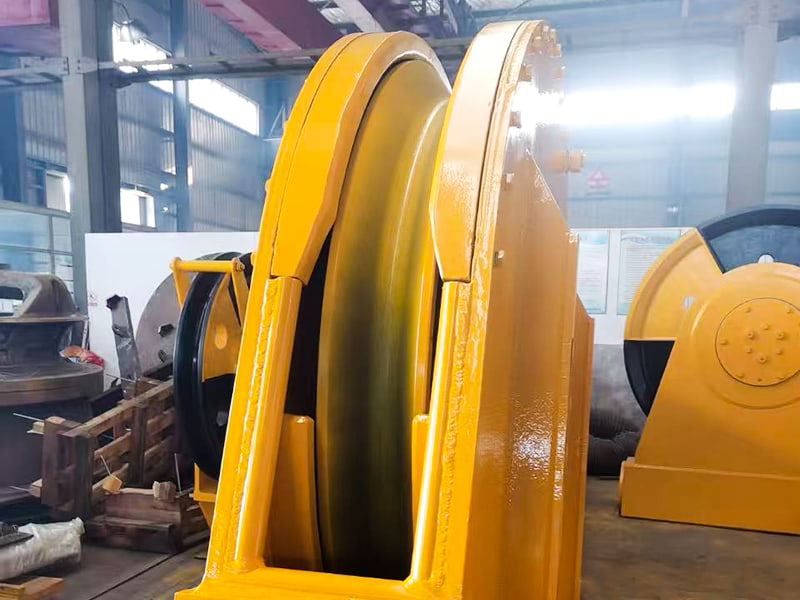 Bridge Pulley Block for Cutter Suction Dredger Power TransmissionGuides cable and adjusts tension in cutter suction dredger drives, using composite pulleys for efficient, compact power transmission across demanding dredging conditions.View Product →
Positioning is the other half of the cycle: the spud winch lifts a heavy spud through the spud well to step the dredger forward, and its brake, pawl and foundation loads are usually the most heavily loaded items in the winch package.
 Spud Installation for Cutter Suction Dredger PositioningTrolley-mounted pile system providing stable support and stepwise positioning for cutter suction dredgers, with hydraulic drive, sensors and guide rails.View Product →
Trailing suction hopper dredgers
Drag winches and the swell compensator behave as one control loop. The winch must pay out and recover wire fast enough to follow the compensator stroke, and the drum has to be sized for the full drag pipe length at the deepest working depth. Hopper winches work the discharge doors and the overflow arrangement, while the gantry winch handles the drag pipe and its bends during maintenance.
Backhoe, grab and bucket ladder dredgers
These vessels use heavy hoist winches with fast lowering and slack-rope protection, plus slewing and spud positioning winches. Cycle time is the measure of success, so brake release timing and acceleration settings matter more than maximum line pull.
Frequently Asked Questions
How much line pull does a drag winch need?
Calculate it from the draghead weight in the soil, the friction of the drag pipe, the maximum dredging depth and the compensator stroke, then add a margin. Copying the figure from a sister ship usually goes wrong, because suction, pipe diameter and soil rarely match.
Hydraulic or electric drive?
Hydraulic where the installation is compact, the loads are shock-dominated or the vessel already has a central hydraulic system; electric VFD where the winch runs for hours or needs precise, repeatable tension. Both must satisfy the same class rules.
How often should winch brakes be tested?
Record a static brake test before each dredging campaign, compare it with the original certificate and repeat after any brake overhaul. A drop of more than about ten percent from certified holding capacity deserves investigation before the winch returns to service.
Getting the Winch Specification Right the First Time
Winch problems seldom appear as broken parts. They appear as slower cycles, more frequent wire rope changes and a crew working around a limitation instead of through it. Fixing duty class, brake holding capacity, drum geometry and control functions at the specification stage costs a few days of engineering; correcting them after installation costs a dry docking.
It therefore pays to involve the winch supplier while the ladder, spud or drag pipe is still being designed, because wire routing and sheave arrangement usually decide the drum dimensions. If you are rebuilding a dredger or specifying a new one, send your duty requirements, wire size and dredging depth to the engineering team and ask for the brake holding capacity and duty class in writing before the order is placed.

Copyright 2025 Taizhou Sanyang Heavy Machinery Co., Ltd. All Rights Reserved Professional Dredging Equipment Manufacturer

Back To Top