
 English
 中文简体
中文简体
What Makes Customized Ship Engineering Equipment the Industry Standard?
Content
The global ship engineering equipment market is currently undergoing a critical transition from standardized production to deep customization. Customized ship engineering equipment is not merely a solution to meet specific vessel-type technical requirements; it is the core means for shipbuilding enterprises to establish differentiated advantages in the high-end market. Data shows that vessels equipped with customized equipment achieve an average energy efficiency improvement of 15% to 25%, reduce equipment failure rates by over 30%, and achieve overall operational lifecycle cost savings of up to 20%.
Driving Factors Behind Customization Demand
Vessel Diversification and Upgraded Technical Standards
The modern shipping industry demands increasingly specialized vessel functions. LNG carriers, polar icebreakers, deep-sea research vessels, and offshore wind turbine installation vessels impose technical specifications far exceeding those of conventional cargo ships in terms of low-temperature resistance, corrosion protection, and precision positioning. Taking polar vessels as an example, their propulsion systems must maintain normal operation in environments as cold as -50℃, and hull structures must meet PC3 class or higher ice-class regulations, forcing equipment suppliers to provide targeted customization solutions.
Environmental Regulations Driving Technological Innovation
The International Maritime Organization (IMO) Carbon Intensity Indicator (CII) and Energy Efficiency Existing Ship Index (EEXI) came into full effect in 2023. To achieve compliance, shipowners are compelled to retrofit existing fleets or adopt customized energy-saving systems in newbuilds. For instance, to meet CII rating requirements, an increasing number of vessels are selecting customized hybrid propulsion systems that automatically switch between diesel and electric propulsion modes based on navigation conditions, achieving measured fuel consumption reductions of 12% to 18%.
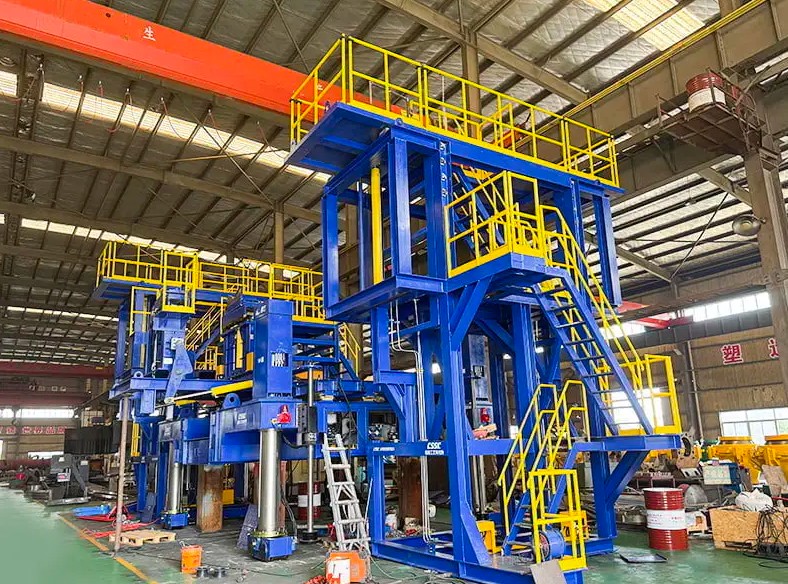
Key Technical Domains of Customized Ship Engineering Equipment
Personalized Design of Propulsion and Power Systems
Propulsion systems represent one of the most highly customized domains. Different vessel types have significantly varying requirements for power, rotational speed, and torque curves:
- Large container ships typically require low-speed two-stroke engines paired with large-diameter propellers, pursuing ultimate propulsion efficiency
- Ro-ro passenger ships and ferries emphasize acceleration performance and low vibration, often adopting medium-speed engines with controllable-pitch propellers
- Offshore engineering vessels such as pipe-laying ships and crane vessels require redundant propulsion units specifically configured for Dynamic Positioning (DP) systems
Targeted Solutions for Corrosion Protection and Materials Engineering
A vessel's service life in salt spray environments directly depends on the customization level of its corrosion protection processes. A complete customized corrosion protection system typically comprises over 20 processes, from nano-silane pretreatment to sacrificial anode protection, forming a multi-layer protective barrier. For vessels operating in highly corrosive waters (such as the South China Sea and the Persian Gulf), customized solutions increase coating dry film thickness to over 350μm and employ combinations of high-performance epoxy primers with polyurethane topcoats, ensuring hull structural integrity throughout a 30-year service life.
Scenario-Based Application of Vibration and Noise Reduction Technologies
Scientific research vessels and naval auxiliary vessels impose stringent limits on underwater noise. Through customized floating raft vibration isolation devices and acoustic optimization design, total vessel radiated noise can be controlled below 100 decibels. A comprehensive research vessel adopting customized double-layer vibration isolation bases and flexible couplings achieved an 85% reduction in main engine room vibration transmission rate, meeting the operational environment requirements for deep-sea acoustic detection equipment.
Typical Application Scenarios and Performance Comparisons
Customized ship engineering equipment has already formed mature application patterns across multiple细分 fields. The table below compares the core performance differences between customized and standard equipment across different application scenarios:
| Application Field | Key Customization Needs | Customized Equipment Advantages | Standard Equipment Limitations |
|---|---|---|---|
| Offshore Wind Turbine Installation | Dynamic positioning accuracy and lifting capacity | DP3-class positioning, lifting accuracy ±50mm | Insufficient positioning accuracy, limited operational windows |
| Deep-Sea Oil & Gas Extraction | High-pressure corrosion resistance and remote control | Adapts to 3,000m water depth, MTBF exceeds 8,000 hours | Low pressure rating, high maintenance frequency |
| Polar Route Transportation | Low-temperature startup and ice-zone reinforcement | Cold start at -50℃, hull strength increased by 40% | Low-temperature failure risk, structural vulnerability |
| Military Stealth Vessels | Radar wave absorption and infrared suppression | RCS reduced by 60%, infrared signature significantly weakened | Strong electromagnetic reflection, easily detectable and lockable |
Supply Chain Coordination and Project Management Challenges
Balancing Design Cycle and Cost Control
The delivery cycle for customized equipment from requirement confirmation to handover is typically 40% to 60% longer than standard products. To compress timelines, leading ship engineering enterprises adopt concurrent engineering models, introducing equipment suppliers during the design phase to participate in hull structure optimization. In an offshore wind turbine installation vessel project, collaborative design between customized leg lifting systems and hull structures reduced the overall construction cycle by 3 months while eliminating 12 tons of redundant structural weight.
Full Lifecycle Data Tracking Systems
The value of customized equipment lies not only in performance parameters at delivery but also in data accumulation across the full lifecycle. Establishing digital archives covering design, manufacturing, installation, and maintenance phases provides critical references for subsequent similar projects. Currently, industry-leading enterprises have achieved real-time data transmission for over 95% of key operating data from customized equipment. Predictive maintenance based on big data analytics can reduce unplanned downtime by 70%.
Industry Development Trends and Strategic Recommendations
Looking ahead, customized ship engineering equipment will present the following development directions:
- Modular Customization Platforms: Combining standardized interfaces with modular subsystems to maintain customization flexibility while shortening delivery cycles, with design cycles expected to be compressed by 30%
- Deep Application of Digital Twins: Completing performance validation and operating condition simulation for customized equipment in virtual environments, reducing the cost and time consumption of physical trial-and-error
- Green Technology Integration: Incorporating carbon capture, ammonia fuel adaptation, wind sail auxiliary propulsion, and other new technologies into customized solutions to meet IMO 2050 net-zero emission targets
- Regionalized Service Networks: Establishing rapid-response service centers for customized equipment at major shipping hubs, reducing fault repair time from weeks to within 72 hours
For ship operating enterprises, when selecting engineering equipment suppliers with deep customization capabilities, priority should be given to evaluating their scale of historical project case libraries, cross-disciplinary technical team configurations, and after-sales service response systems. During contract negotiation, it is recommended to clearly define performance guarantee clauses and full lifecycle technical support plans, converting customization investments into quantifiable operational benefits.

Copyright 2025 Taizhou Sanyang Heavy Machinery Co., Ltd. All Rights Reserved Professional Dredging Equipment Manufacturer

Back To Top