
 English
 中文简体

How to Maintain a Dredger Gantry: Routine Checks, Greasing and Structural Care
Content
- 1 What the dredger gantry actually carries
- 2 The shift walk-around: ten minutes, ten checks
- 3 Greasing, pins and bearings: the cheapest reliability spend
- 4 Wire rope, sheaves and blocks
- 5 Cylinders, hoses and the swell compensator
- 6 Structure: welds, fitted bolts and NDT
- 7 Spares, docking cycle and records
- 8 Frequently asked questions
A locking pin that needs a pry bar to slide home. A hoist sheave that runs a few degrees warmer than the one beside it. A grease fitting that stopped taking grease a fortnight ago. On a trailing suction hopper dredger, the gantry rarely fails without warning — it fails after weeks of signals nobody wrote down.
The conclusion first: maintaining a dredger gantry is four routines stacked on top of each other. A visual walk-around every shift, greasing and pin checks every week, wire rope and sheave and cylinder inspection every month, and structural NDT plus alignment work at every docking. Everything else — spares strategy, crew training, record keeping — exists to keep those four routines honest.
Two habits pay for themselves quickly. Grease until clean grease shows at the seal, not until the gun feels heavy. And log every point you greased with the date and the position number used on the parts drawing — when a hinge pin starts to seize, that log is the difference between a bearing change and a gantry repair.
What the dredger gantry actually carries
The gantry is the A-frame structure that carries the drag arm and draghead over the stern or the side of the vessel. It is not a single beam. The assembly includes the main frame, hinge lugs and pins, hoisting sheaves and guide blocks, lifting cylinders, locking pins for the sailing condition and, depending on design, the mounting points for the swell compensator. Every load the draghead meets in the water arrives here as a dynamic load and leaves through pins, sheaves and welds.
Why the load pattern changes the plan
A draghead working in swell produces thousands of small cycles rather than one big overload. That is why gantry damage usually shows up as fretting at pin seats, elongated bolt holes, cracked paint at weld toes and sheave grooves worn slightly oval. It is also why "it still works" is a poor inspection standard: the structure tolerates those cycles only while clearances stay inside tolerance.
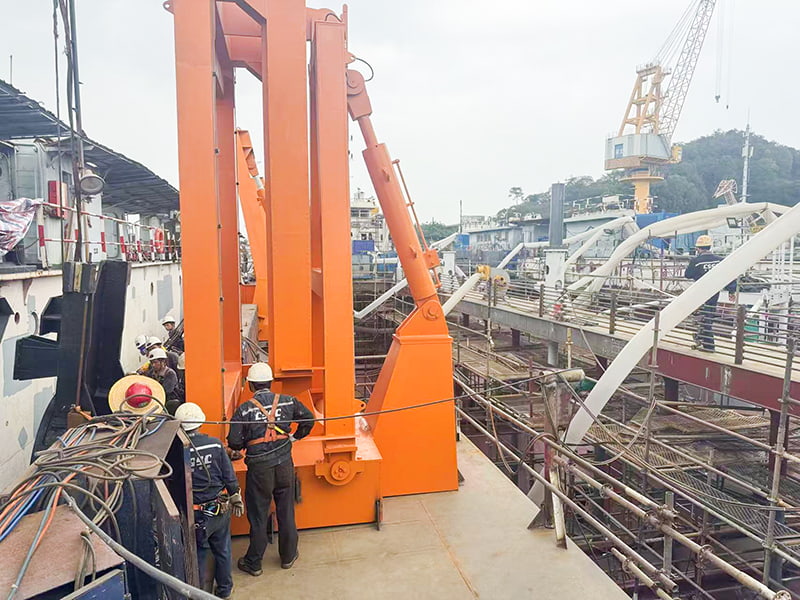 Trailing Suction Hopper Dredger Gantry and HangerKey load-bearing structure linking hull to hopper head, supporting 50–300 tons and helping maintain positioning and depth control under cyclic dredging loads.View Product →
When you need a replacement or a dimensional match, work from the component list rather than the drawing title — the trailing suction hopper dredger components range groups the gantry with drag pipe, side wire blocks and related assemblies so the right part number is easier to confirm.
The shift walk-around: ten minutes, ten checks
Walk the gantry before the dredge pump starts, not after. With the drag arm stowed, look for:
- Oil weep past cylinder rod seals or under hose end fittings.
- Rope spooling evenly on the drum — no crossed wraps, no flat spots.
- Sheaves turning freely by hand, no rocking on the bearing, no rope-polished grooves.
- Retainers and cotter pins present, wired and correctly oriented.
- Fretting or bright marks at hinge lugs and bracket toes.
- Locking pins travelling fully in and out, with bridge feedback confirmed.
- Hose chafe at guide rings and worn sleeving.
- Coating breakdown and rust bloom in the splash zone.
- Access clear — ladders and walkways free of grease.
- Drain holes open so water cannot stand inside the structure.
Report against the position number, not "the A-frame". A two-line message — starboard hoist sheave, position 14, running warm, groove polished — gets action. "Gantry noisy" does not.
Greasing, pins and bearings: the cheapest reliability spend
Most lubrication-related gantry failures are not caused by the wrong grease. They are caused by intervals written for a crane rather than a dredger, where salt, grit and constant movement pull lubricant out of a pin joint far faster than a load chart suggests.
| Point | Typical interval | What "correct" looks like | If skipped |
|---|---|---|---|
| Gantry hinge pins and bushes | Weekly, shorter in swell season | Fresh grease at both seals; pin turns by hand with arm stowed | Seized pin, oval bush, lug repair |
| Hoist sheave bearings | Weekly | Free rotation, no rumble, no grease weep | Grooved sheave, rope damage, hot bearing |
| Hoist and side wire ropes | Monthly and after heavy lifts | Rope dressed, lubricant worked into the strands | Internal corrosion, hidden broken wires |
| Cylinder rod ends and pins | Weekly | Clean grease at the pin, no water in the eye | Pin wear, rod-end cracking |
| Locking pins and guides | Weekly and before every sail | Full travel, no galling on the sleeve | Pin stuck mid-travel, gantry unlocked at sea |
| Compensator guide surfaces | Condition-based, per maker | Free sliding, no scoring, pre-charge on spec | Shock loads pushed into the frame |
One caution: over-greasing a sealed bearing is as damaging as under-greasing. If a seal bulges or a relief port stays blocked, stop and clean instead of pumping harder.
Wire rope, sheaves and blocks
Inspect rope where it bends
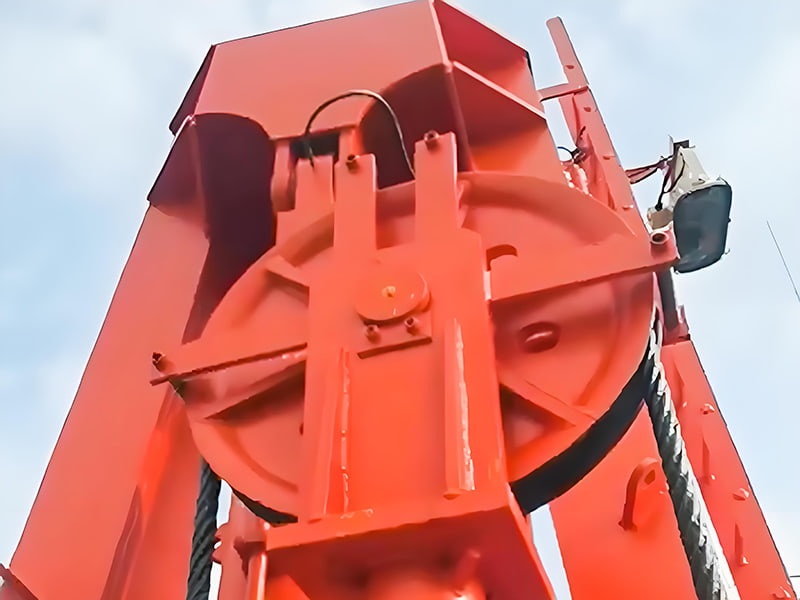
Hoist ropes on a gantry die at the sheave, not in the straight run. Bend the rope over a rag at each sheave exit and look for broken wires, bird-caging, kinking and diameter reduction. Rejection criteria should come from the rope maker and the class surveyor and should be written into the plan, so the decision is not made in a hurry at the quay.
Measure sheaves, don't just look
A worn groove is a rope-killer. Check groove diameter, groove shape and corrugation with a gauge at each docking, and check free rotation and bearing end float monthly. Keeping one spare sheave set aboard is often cheaper than an unplanned rope change.
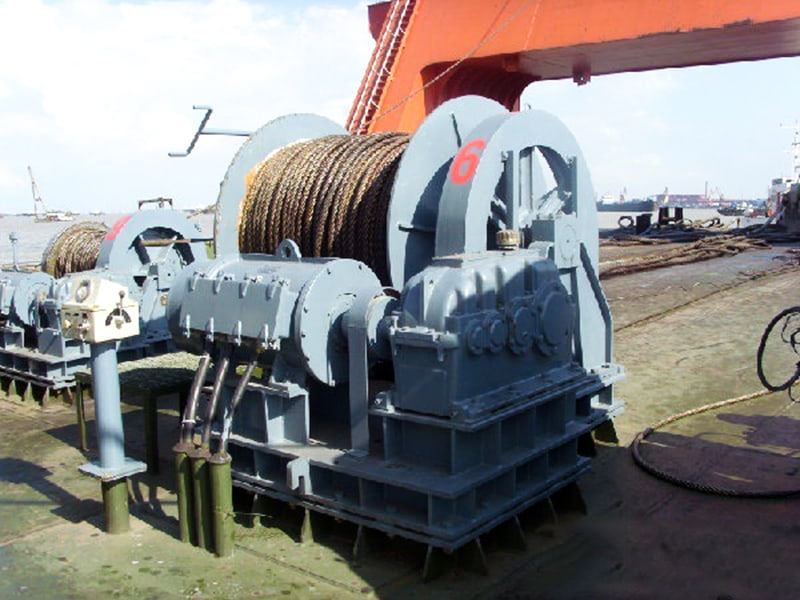 Dredger Winch for Trailing Suction Hopper DredgersPower centre for the dredging winch system, controlling draghead raising, lowering and positioning with 800–1200 kN pulling force for precise depth control.View Product →
Brakes hold the arm, so they hold people
Band or disc brakes on the hoist winch secure the drag arm while the gantry is being worked on. Prove holding capacity with the arm stowed before anyone goes under the structure, and check for oil on the drum flange.
Cylinders, hoses and the swell compensator
Cylinder maintenance is mostly about protecting the rod. A scored or pitted rod destroys the seal from the outside in, and grit carried into the oil eventually finds every valve downstream.
- Dress or replace any rod with scoring, pitting or lifted chrome.
- Drift-test with the arm slightly raised and the pump off: mark the rod, time the creep.
- Date-code hoses and replace on schedule, not on appearance.
- Confirm accumulator pre-charge before each swell season.
 Swell Compensator for Hopper Dredger SystemsHeave compensator offsets wave-induced vessel motion, maintains draghead ground pressure within ±5% and absorbs shock loads to protect pipelines and structure.View Product →
The compensator deserves its own line in the plan because it absorbs the loads the gantry cannot be designed away from. A lazy compensator — low pre-charge, sticky guides, hunting pressure — passes those cycles straight into the frame and pins.
Structure: welds, fitted bolts and NDT
Structural inspection is where crews most often settle for "looks fine". Paint hides cracks very effectively, and the high-risk locations are predictable: weld toes at hinge lugs, stiffener ends, bracket toes at the deck connection, and any change of section.
- Clean and inspect those four zones at every docking; use MPI or penetrant where the surveyor requires it.
- Check fitted bolts for witness-mark movement, re-torque to drawing value and record it.
- Gauge plate thickness in the splash zone — corrosion allowance is a design feature, not a permanent gift.
- After sheave or bearing work, verify sheave alignment and rope fleet angle before the first lift.
- Compare hinge pin clearance with tolerance and re-bush before the pin starts hammering the lug.
When repair is needed, matching the original material grade and weld procedure matters more than speed. An unqualified weld at a lug is a fatigue crack waiting for the next swell.
Spares, docking cycle and records
A plan that cannot survive a missed delivery is not a plan. Keep a small critical set aboard or in the yard: one sheave assembly, a hinge pin and bush set, cylinder seal kit, one hoist rope set and the hoses that fail most often.
- Map every gantry item to a position number used in the parts list and drawing.
- Set intervals by duty — exposed-water work needs shorter greasing and rope checks than sheltered harbour work.
- Record measurements, not just pass or fail: groove diameter, pin clearance, brake holding, bolt torque, rod drift.
- Review the log before and after each docking; a repeat defect is an operating or design question, not a lubrication one.
Frequently asked questions
How often should a dredger gantry be greased?
Weekly is the normal baseline for hinge pins, sheave bearings and cylinder pins, with a shift-level top-up after long periods of heavy swell or extended drag-arm hours. Sealed bearings follow the maker's volume, not "more is better".
What is usually the first sign of trouble?
A change in sound or effort: a pin that needs help to seat, a sheave running warm, or a rope that stops spooling neatly. Any of the three justifies an inspection the same shift.
Can gantry work be done afloat?
Hydraulic and most cosmetic work can, with the drag arm secured and the area isolated. Structural weld repairs at hinge lugs and load-bearing brackets belong in dry dock, with NDT and surveyor attendance.
Gantry maintenance rewards boring consistency far more than skill in a crisis. If you need drawings, tolerances or spare-part positions confirmed against the gantry already on your vessel, send the arrangement drawing and our engineering team will match it to the parts list.

Copyright 2025 Taizhou Sanyang Heavy Machinery Co., Ltd. All Rights Reserved Professional Dredging Equipment Manufacturer

Back To Top