
 English
 中文简体
中文简体
Cold Bending Machine for Pipe Fabrication: Buyer's Guide for Shipyards
Content
- 1 What a Cold Bending Machine Actually Does
- 2 Why Shops Choose Cold Bending Over Hot Bending
- 3 Sizing the Machine: Diameter, Wall Thickness and Tolerance
- 4 Pipe Grades: What Bends Cleanly and What Fights Back
- 5 Mandrels, Die Sets and Springback Control
- 6 A Buyer Checklist for Pipe Fabrication Machines
- 7 Cold Bending in Shipyard and Dredger Work
- 8 Purchase Risks That Only Appear After Delivery
- 9 Maintenance and Safe Operating Habits
- 10 Frequently Asked Questions
A DN300 carbon steel pipe comes out of the bender at a clean 45 degrees with an ovality gauge reading of 9 percent. ASME B31.3 caps ovality on a bend at 8 percent of nominal diameter, so the spool is scrap before it ever reaches a welder. Nothing was wrong with the machine. The setup was wrong, and the setup is decided long before the machine is ordered.
That is the whole argument for shopping carefully. A cold bending machine for pipe fabrication is not judged by the largest angle on its specification sheet, but by how repeatably it produces a bend that still passes inspection after the hydraulics release. The practical answer: size the machine on outside diameter, wall thickness and minimum bend radius, insist on a mandrel system, and require a documented trial bend on the exact pipe grade you run. Everything else is detail, and the detail is where the money is saved.
What a Cold Bending Machine Actually Does
Cold bending forms pipe at ambient temperature. No torch, no induction coil, no furnace. In pipe fabrication the dominant method is rotary draw bending: a hydraulic cylinder rotates a bend die while a clamp die holds the leading end of the pipe, a pressure die supports the trailing straight, and a mandrel sits inside the bore to keep the cross section round.
Three forces have to cooperate at once:
- Clamping force at the leading end, which stops the pipe slipping as the die rotates.
- Bending moment applied through the die, which sets the angle and the radius.
- Internal support from the mandrel, which stops the inside of the bend wrinkling and the outside collapsing.
Get the balance wrong and you get the classic defects: wall thinning on the outside of the arc, wrinkling on the inside, and ovality through the bend. Press-style benders push pipe against a fixed form. They are fast on structural sections, but hollow pipe crushes far too easily under that geometry. For fabrication work, rotary draw is the process that matters.
The underlying mechanics are worth understanding before you compare quotations, and this plain-language overview of how a cold bending machine works covers the basics without the marketing gloss.
Why Shops Choose Cold Bending Over Hot Bending
For most shipyard piping and process pipe up to roughly DN600, cold bending is cheaper, faster and more consistent than hot bending, provided the machine and tooling match the job. The reason is not that heat is inherently bad. It is that heat adds steps: heating, temperature control, controlled cooling, and sometimes post-bend heat treatment to restore properties.
Cold bending skips all of it. There is no scale to grind off before welding, no heat-affected zone to qualify, and no distortion from uneven cooling. What you do get is strain hardening, which raises yield strength slightly at the bend and lowers ductility. That is acceptable in most cases, but it has to be accounted for on thin-wall or low-temperature service.
| Factor | Cold bending | Hot bending |
|---|---|---|
| Forming temperature | Ambient, no intentional heating | Typically 850 to 950 C |
| Effect on parent metal | Strain hardening, no heat-affected zone | Microstructure changes, may need heat treatment |
| Surface condition | Clean, ready to weld | Scale and oxide layer to remove |
| Repeatability | High with CNC and springback compensation | More sensitive to uneven heating |
| Typical use | Shop pipe spools, shipyard piping, small to medium bore | Very thick wall, very tight radius, large diameter |
Sizing the Machine: Diameter, Wall Thickness and Tolerance
Three numbers decide whether a machine fits your shop: maximum outside diameter, maximum wall thickness at that diameter, and minimum bend radius. If any of the three is vague in a quotation, that quotation cannot be compared with any other.
Bend radius is quoted in pipe diameters
A 3D bend on a DN200 pipe has a centreline radius of 600 mm. Three diameters is roughly the practical floor for rotary draw bending. Five diameters is comfortable for volume work, and anything from 10D upward is easy to form and easy to support. Tight bends are where mandrels, wiper dies and extra tonnage all become unavoidable.
Wall thickness and the diameter-to-thickness ratio
The ratio of outside diameter to wall thickness is the single best predictor of difficulty. Low ratios, meaning thick wall relative to diameter, form cleanly and rarely need elaborate tooling. High ratios mean thin wall, and thin wall is where wrinkling and collapse begin. A rule of thumb many shops use: below about 20:1 a plug mandrel is often enough, above that a ball mandrel becomes the safer choice, and above roughly 50:1 you should be asking hard questions about whether the bend is achievable at all.
Two tolerances to write into the purchase order
- Ovality. ASME B31.3 limits the difference between maximum and minimum diameter at any cross section of a bend to 8 percent of nominal diameter.
- Wall thinning on the extrados. The finished wall thickness at the outside of the bend must still meet the minimum required for the design pressure.
Springback belongs in the same conversation. Carbon steel typically springs back 2 to 5 degrees after the load releases, and the amount grows with radius and yield strength. A control system that compensates for springback automatically is not a luxury on repeat production; it is the difference between one setting and one setting plus constant adjustment.
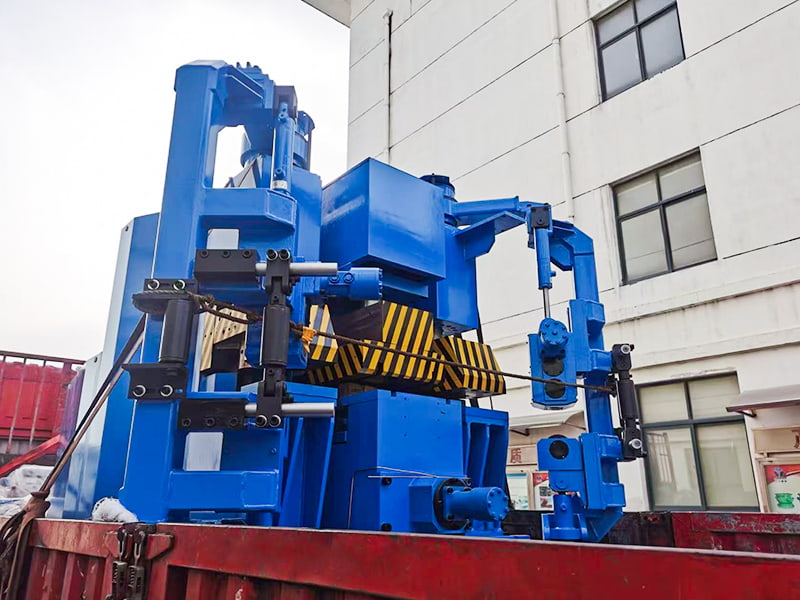 Cold Bending MachineProduct Series: 400T, 600T, 700T, etc. A cold-bending machine uses a cold forming process to shape steel plates into a variety of complex hull surfaces. As the mainsta...View Product →
Pipe Grades: What Bends Cleanly and What Fights Back
Carbon steel is the easy case. A106 Grade B, A53 and API 5L grades up to X70 all cold bend predictably with a matched die set and a mandrel. Springback stays modest, and the process is well understood.
Austenitic stainless is a different conversation. Grades 304 and 316 work harden as they deform, so the material resists the bend more the further you push it. Tooling has to be polished, radii are usually opened up, and springback climbs noticeably compared with carbon steel. Duplex and super duplex grades are harder again and demand heavier machines and slower ram speeds.
Heat is not the answer in these cases. A larger radius, a better mandrel or slower forming usually is. If a supplier promises a tight-radius stainless bend with no special tooling, ask to see the trial bend report before you sign anything.
Mandrels, Die Sets and Springback Control
Tooling decides bend quality far more than machine tonnage does. Four components carry most of the responsibility:
- Bend die. Sets the centreline radius. You need one per radius, not one per angle.
- Clamp die. Grips the leading end. A worn clamp die slips, and slipping turns good pipe into scrap.
- Pressure die. Supports the trailing straight and is often paired with a wiper die on tight bends.
- Mandrel. Plug, formed or ball type, linked by a mandrel rod and positioned by a follower.
Ball mandrels are the usual choice on thin-wall pipe because each ball supports the inside of the arc progressively as the bend advances. Plug mandrels are sufficient when the ratio is low and the bend is generous. Wiper dies matter most on aluminium and stainless, where the material tends to bunch ahead of the tangent point.
A Buyer Checklist for Pipe Fabrication Machines
Before you compare quotations, put these six points in writing and send them to every supplier. The answers will separate serious builders from assemblers.
- Rated outside diameter and the maximum wall thickness at that diameter, stated separately.
- Minimum bend radius expressed as a multiple of pipe diameter, with the wall thinning expected at that radius.
- Control axes offered: bend angle alone, or bend angle plus feed and rotation.
- Whether a trial bend on your own pipe grade, with your own wall thickness, is included.
- Die and mandrel lead times, plus the cost and availability of spare clamp dies.
- Service response time and the location of the nearest support engineer.
Cold Bending in Shipyard and Dredger Work
Shipyard pipe fabrication is a low-volume, high-variety job. A single vessel carries ballast, bilge, fuel, lube oil, seawater and hydraulic systems, with bore sizes running from DN25 to DN400 and bend angles scattered across the whole range. Many spools are one-offs. Under those conditions the machine's real limit is not its maximum diameter; it is how fast a die set can be changed and how quickly a new program can be set.
Dredging equipment points in the other direction. Suction and discharge piping on a cutter suction dredger carries abrasive slurry at high velocity, so walls are thick and wear protection matters. Bends in that service are formed to close tolerances because a mismatch at the field joint means cutting out a finished spool. A heavy-duty machine and a properly matched mandrel set are what keep those spools inside tolerance.
Both environments reward the same habit: treat bending as a controlled process rather than an operator's feel. Shop-floor tooling such as the 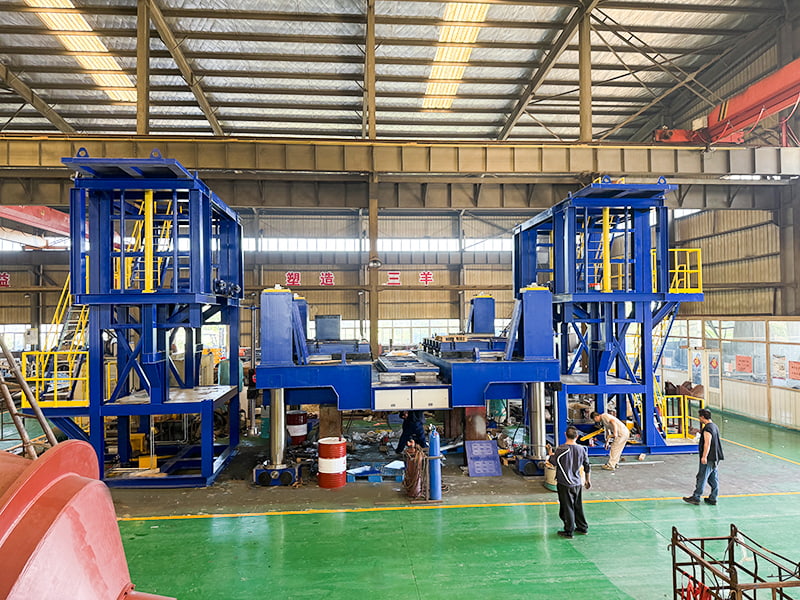 Rudder Slurry Installation PlatformThe propeller installation platform in marine engineering is a precision tooling system designed specifically for the integrated assembly of large-scale ship propulsio...View Product → follows the same logic, providing a stable, repeatable base so that alignment and fit-up stay consistent from one unit to the next.
Purchase Risks That Only Appear After Delivery
The most common failure is not a machine that underperforms. It is a machine that was specified one size too small. Several patterns repeat across projects:
- Capacity quoted at nominal maximum diameter but at the thinnest wall, so the machine stalls once real wall thickness arrives.
- Single-axis control on a shop that runs dozens of different spools per week.
- One die set supplied, turning die changes into the production bottleneck.
- Trial bends run on the builder's sample pipe rather than the buyer's actual material.
- No agreement on spare parts, training or on-site commissioning.
Each of these is cheap to fix before the order and expensive afterward.
Maintenance and Safe Operating Habits
Hydraulic cold bending machines are robust, but they are unforgiving about contaminated oil and worn tooling. Keep hydraulic fluid clean and change filters on schedule. Inspect clamp and pressure dies for wear every few thousand bends, because a die that has lost its profile will produce ovality long before it looks obviously damaged. Check mandrel rods for straightness, and verify the mandrel position setting after any tooling change.
On the safety side, keep hands clear of the die closing area during the cycle, use two-hand control where it is fitted, and never reach into the bend zone while the machine holds pressure. Support long pipe on roller stands so the operator is not fighting the weight of the spool at the same time as the control panel.
Frequently Asked Questions
Does cold bending always require a mandrel?
No. Generous bends on thick-wall pipe often form cleanly without internal support. Once the diameter-to-thickness ratio climbs, a mandrel becomes the economical choice because it prevents wrinkling rather than repairing it later.
Can cold bending damage the pipe?
It thins the wall on the outside of the bend and hardens the material slightly. Both effects are predictable and manageable through radius selection, tooling and process control. Uncontrolled bending, on the other hand, produces scrap.
What is the smallest radius I should design around?
Three diameters is the practical floor for rotary draw bending, and five diameters is far kinder to tooling and to throughput. If the layout allows, design around 5D and the machine will last longer.
How long does a cold bending machine take to deliver?
Standard hydraulic machines are typically weeks rather than months, but custom die and mandrel sets often take longer than the machine itself. Order tooling in parallel, not afterward.
Machine sizing is the decision that is hardest to reverse and easiest to get right at the start. Work out your largest bore, your heaviest wall and your tightest radius, then confirm that the machine can hold ovality within 8 percent and keep wall thinning inside the design minimum on a real trial bend. Do that before the purchase order goes out, and the shop floor will not surprise you six months later.
If you want a second opinion on capacity and tooling before you commit, contact our engineering team and send across your pipe schedule and bend list.

Copyright 2025 Taizhou Sanyang Heavy Machinery Co., Ltd. All Rights Reserved Professional Dredging Equipment Manufacturer

Back To Top