
 English
 中文简体

How China Dredging Equipment Exports Are Growing: Drivers and Buyer Checks
Content
- 1 What Is Actually Driving the Growth
- 2 Where the Growth Shows Up
- 3 What Actually Ships: Cutter Suction and Hopper Components
- 4 What to Verify Before the Order Leaves the Quotation Stage
- 5 Beyond the Dredger: Adjacent Exports That Travel With It
- 6 Where the Growth Meets Its Limits
- 7 Frequently Asked Questions
The short answer: China's dredging equipment exports are growing because the country first built a large domestic dredging and land-reclamation fleet, then turned the component supply chain behind that fleet into an export business. The growth is concentrated in parts — cutter heads and teeth, suction bends, spuds, dragheads, winches, hopper doors, ball joints, wear liners — rather than in complete dredgers. That distinction matters, because component orders move faster than newbuild contracts and reach a procurement desk months earlier.
Consider a familiar scene. A contractor runs two cutter suction dredgers on a channel-deepening campaign. The cutter head and teeth are near the end of their wear life and the next campaign starts in a few weeks. Three enquiries go out. One quotation returns with a fixed delivery date, a welding procedure and an inspection plan attached. One returns with a date range. The third returns asking which revision of the drawing is current. Increasingly, the first reply comes from Jiangsu, Guangdong or Shanghai — which is why export volumes have kept climbing even where new vessel orders are flat.
For a buyer, the practical translation is simple: sourcing dredge parts from China is no longer primarily a cost experiment, it is a lead-time and availability decision. What follows explains what is driving the shift, where it shows up, and which checks keep the decision a good one.
What Is Actually Driving the Growth
Four forces explain most of the export curve. None of them is new, but they now reinforce each other.
Domestic fleet first, export second
China's reclamation and port-construction programme required a large fleet of cutter suction and trailing suction hopper dredgers, plus the yards, foundries and machining shops needed to keep them working. That domestic demand built a component base with deep experience in the parts that actually fail in service: dredge arm pieces, bridge pulley blocks, suction bends, spud installations, dragheads and turning glands. When domestic newbuild demand cooled, that capacity looked outward. Export growth is, in large part, the same factories selling the same parts against a different map.
Components before vessels
A new dredger is a multi-year decision; a worn cutter head is a this-quarter decision. Because Chinese suppliers built depth in the component layer, they entered through the faster-moving door. A yard or owner that would not tender a complete vessel abroad will still collect three quotes on a suction bend, a set of cutting teeth or a spud assembly. Each order is small, but they repeat — and they build the reference list that later supports larger system orders such as complete dredge arms, shaft and rudder sets, or hydraulic clamp systems.
Certification stopped being the objection
A decade ago the standard objection to Chinese heavy machinery was documentation: no traceable material certificates, unclear welding procedures, no third-party witness points. That objection has largely been answered. Manufacturers in the sector now hold CCS ISO 9001-2015 certification and are recognised by CCS, BV, ABS and RINA, which means inspection and certification can be planned into the order instead of argued about afterwards.
Non-standard engineering is the real product
Dredging components are rarely catalogue items. A suction bend has to match an existing pipeline flange, a cutter head has to suit a specific tooth system and drive, a hopper door has to close against a worn coaming. The export offer is therefore not a part number — it is the ability to manufacture from a drawing, or to reverse-engineer from a worn part plus a set of interface dimensions. Buyers who understand this get better results than buyers who shop purely on price per kilogram, because the cost of a part that does not fit is not the price of the part.
Where the Growth Shows Up
Export growth is not evenly spread. The pattern below reflects the order mix that typically appears when a Chinese dredging component manufacturer reports destinations across Europe, the Americas and Asia.
| Market | What is usually ordered | What decides the order |
|---|---|---|
| Western and Northern Europe | Wear and structural parts for cutter suction dredgers: cutter heads, cutting teeth, arm pieces, suction bends | Welding and coating documentation, recognised material grades, confirmed delivery date |
| United States | Replacement assemblies and ball joints for existing fleets, often reverse-engineered | Dimensional interchangeability and speed, since downtime is the dominant cost |
| Brazil and Chile | Complete component sets for dredgers assembled or refitted locally | Consolidated freight, price stability and remote installation support |
| Japan | Precision-machined parts, shaft and rudder assemblies, matched sub-assemblies | Tolerance control and inspection reports rather than price |
| Adriatic and Mediterranean | Mid-size structural components, spud installations, winches and gantries | Certification route and the ability to visit the works before shipment |
Two patterns stand out. European and Japanese buyers tend to order fewer, better-documented parts and care about traceability. Latin American buyers more often order a full set for a single hull and care about freight consolidation and support during installation. Same factories, different purchase orders.
What Actually Ships: Cutter Suction and Hopper Components
Two dredger types account for most of the component export volume, and they behave differently in procurement.
Cutter suction dredger components
A cutter suction dredger is a wear machine mounted on a ladder, so the parts that move are the parts that sell. These are also the easiest items to specify from a drawing, which makes them the entry point for most first orders. For an overview of how they fit together, see this guide to the components of a cutter suction dredger.
- Cutter head, cutter drive assembly and cutting teeth, where abrasive wear dominates
- Dredge arm pieces and bridge pulley block, where structural fatigue meets abrasion
- Suction bend with arm pieces and swivel bend, the highest-wear section of the pipeline
- Spud installation and bow coupling, where alignment tolerance decides service life
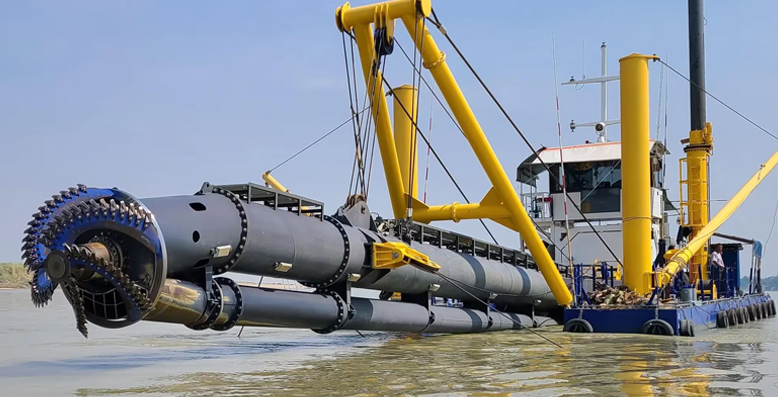 Cutter Suction Dredger Wear and Mechanical ComponentsComponents for cutter suction dredgers, including cutter heads, teeth, bends and wear rings, suited to drawing-based specification and first orders.View Product →
Trailing suction hopper dredger components
A trailing suction hopper dredger buys a different set: bow connection, drag pipe, cardanic joint, draghead, side-wire block, turning gland, hopper door, winch, gantry, gate valve, overflow duct, self-emptying door and swell compensator. The draghead and drag pipe are consumables in all but name, the hopper door and gate valve are sealing problems, and the winch and gantry are mechanical. Ordering these against a single drawing package usually reduces both freight and inspection cost.
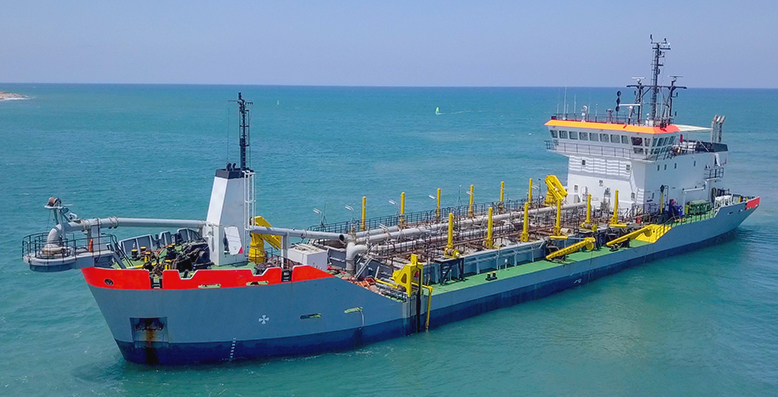 Trailing Suction Hopper Dredger ComponentsComponents for self-propelled trailing suction hopper dredgers, including dragheads, drag pipes, hopper doors, winches and gantries; useful when reviewing interfaces and export documentation.View Product →
| Component group | What drives replacement | Stocking advice |
|---|---|---|
| Cutter head and cutting teeth | Abrasive soil, rock content, cutting speed | Treat teeth as consumables; hold one campaign's worth |
| Suction bend and arm pieces | Inner-curve abrasion from sand and gravel | One spare per dredger; measure wall thickness at every refit |
| Ball joint | Seal and liner wear, plus alignment drift | Stock seal and liner kits rather than a complete unit |
| Spud installation | Mechanical shock and bending, not abrasion | Inspect and re-machine; keep pin and bush sets |
| Hopper door, gate valve, overflow duct | Slurry abrasion and seal fatigue | Seals and actuators first; structure on condition |
| Winch and side-wire block | Wire rope wear and brake lining | Rope and brake parts in stock; sheaves inspected |
What to Verify Before the Order Leaves the Quotation Stage
Most disappointing export purchases fail on paperwork and interfaces, not on machining quality. Six checks cover the majority of the risk:
- Drawing revision and interface dimensions. Confirm flange standard, bolt circle, keyway size and centre distances. A part that matches the drawing but not the ship is a scrap part.
- Material and traceability. Ask for mill certificates and a stated grade equivalence, plus impact testing where the vessel works in cold water.
- Welding and non-destructive testing. WPS and qualification records, NDT coverage and whether class witness points apply should be written into the order, not agreed verbally.
- Coating and wear protection. Surface preparation grade, dry film thickness and hardfacing on wear zones decide how long the part lasts in abrasive ground.
- Packing and lifting. Sea freight rewards sensible packaging: treated timber, marked lifting points and match-marking for on-site assembly.
- Handover documents. As-built drawings, a wear-part list and a recommended stock holding are the difference between a supplier and a spare-parts partner.
Beyond the Dredger: Adjacent Exports That Travel With It
Dredge components rarely travel alone. A yard fitting out a dredger or a support vessel often consolidates other heavy items into the same shipment: shaft and rudder sets for vessels from 20,000 to 200,000 DWT, pile-driving hydraulic clamp systems, cold bending machines and installation platforms. Because these sit in the same engineering and certification environment, buyers increasingly source them from the same manufacturer rather than assembling a new supplier relationship for each item.
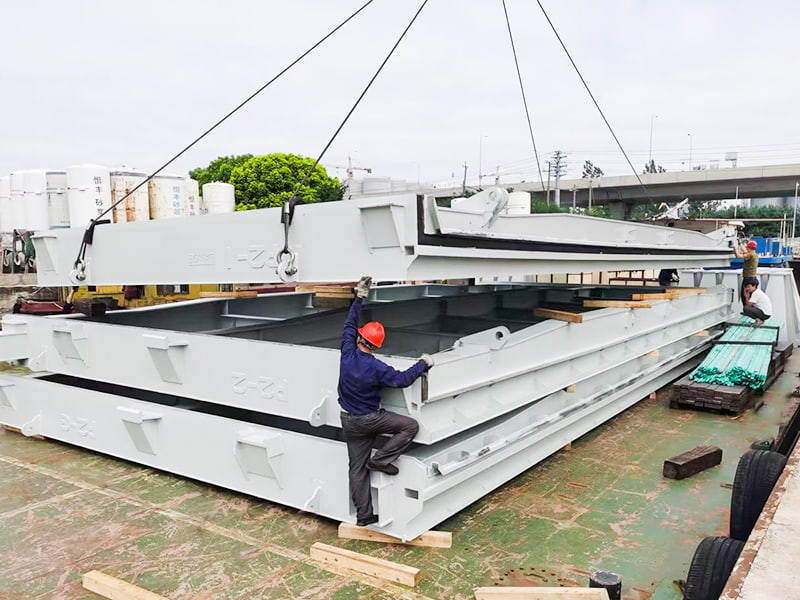 Marine Shaft and Rudder SystemsPropeller shafts, rudder assemblies and hatch covers for marine and offshore vessels, suited to consolidated heavy-equipment shipments.View Product →
That consolidation is one reason export value grows faster than unit counts. A single order that starts with a set of cutting teeth can end with a shafting package, and the inspection plan is written once for both.
Where the Growth Meets Its Limits
None of this makes the supply base frictionless. Four constraints consistently show up in practice:
- Engineering bandwidth. Reverse-engineering a worn part works well when someone on the buyer's side can confirm the interface dimensions. Without that, guesswork gets expensive.
- Freight and packing quality. Long sea routes punish poor crating; the cheapest freight option often costs more in rework than it saves.
- Warranty geography. Returning a part can cost more than the part itself, so agree a repair-or-credit mechanism before the order is placed.
- Price discipline. The lowest quote often excludes NDT, class witness, coating or documentation. Compare scopes, not totals.
Each of these is a reason to write a tighter purchase order rather than a reason to avoid the market.
Frequently Asked Questions
Are Chinese dredge components interchangeable with European-built dredgers?
Generally yes, for parts defined by drawings and interface dimensions. Send the drawing or the worn part together with flange standard, keyway details and centre distances, and ask for the inspection report against those dimensions before shipment.
How long does an export order take?
It depends far more on castings, forgings and hardfacing than on machining. Standard parts made from existing drawings move quickly; reverse-engineered items need a sample check first. Ask for a milestone schedule rather than a single promised date.
Do I need a class society involved?
For components tied to the vessel's classification — rudder stocks, shafting, structural items — yes. For wear parts such as teeth and suction bends, formal class involvement is usually unnecessary, but material and welding documentation still matters.
What about spares after delivery?
Ask at order stage, not after the first failure. Wear-part drawings and a recommended stock list cost nothing to request and shorten every future breakdown.
Export growth has moved Chinese dredge components from an exception to a normal sourcing option. The buyers who get the most from it treat it exactly that way: they specify precisely, they inspect against drawings, and they plan spares before a part fails rather than after.
If you are working from a drawing, a worn part or a fixed delivery window, send the details and the required date — a useful reply will tell you what is manufacturable as drawn, what needs a class inspection plan, and what the realistic schedule looks like.

Copyright 2025 Taizhou Sanyang Heavy Machinery Co., Ltd. All Rights Reserved Professional Dredging Equipment Manufacturer

Back To Top