
 English
 中文简体
中文简体
Drag Head Visor vs Plain Suction Drag Head: Key Differences for TSHD Buyers
Content
- 1 What Is a Drag Head Visor?
- 2 Plain Suction Drag Head: The Simpler Workhorse
- 3 Drag Head Visor vs Plain Suction Drag Head: Key Differences
- 4 How Soil Type Drives the Choice
- 5 Production Impact: Where the Visor Earns Its Keep
- 6 Wear, Maintenance, and Total Cost of Operation
- 7 Selection Checklist for TSHD Operators
- 8 Frequently Asked Questions
Choosing between a drag head visor and a plain suction drag head is one of those decisions that looks simple on paper but affects production, wear, and crew workload every single dredging day. The visor design gives the operator real-time control of the water-to-soil ratio at the intake, while the plain suction drag head offers a simpler, lower-maintenance alternative for consistent, loose soils. If your ground conditions vary within one project or between projects, a visor is usually the better investment; if you mostly pump uniform fine sand, a plain suction drag head may be enough.
What Is a Drag Head Visor?
A drag head visor is a movable shield or flap mounted at the front of the drag head. It is usually connected to the visor carrier with heavy-duty hinges and can be opened or closed hydraulically or by a mechanical linkage. The visor controls the amount of water entering the suction mouth along with the sediment. By adjusting the opening, the dredge master changes the mixture density and tunes the vacuum in the suction pipe. In loose sand, the visor can reduce water intake to increase the concentration of sand; in compact soil, it can be opened wider to allow a higher flow of water that helps break up and carry the material.
A typical visor assembly includes a visor carrier, movable visor, hinge pins, and wear protection plates. The design is similar to a jaw or flap, pivoting at the bottom or top. The position can be adjusted from the bridge, which allows operators to react to changing ground conditions without stopping the dredger. For a trailing suction hopper dredger, this is significant because the seabed is rarely homogenous along the dredge track.
Plain Suction Drag Head: The Simpler Workhorse
The plain suction drag head is the conventional, non-visor design. It has a fixed or manually adjustable opening, usually with a lattice or vertical bars to prevent large objects from entering the suction pipe. In operation, the water and soil mixture enters through the opening as the head is dragged along the seabed. The absence of a movable visor means the intake area stays constant during a pass. If the material becomes coarser or denser, the operator can only change the dredging speed or pump speed, not the intake geometry.
This simplicity brings real benefits. There are fewer moving parts, fewer hinge pins, and less exposed mechanism to suffer impact damage. For projects where the seabed consists of uniform fine sand or soft silt, the plain suction drag head often achieves excellent production with lower initial cost and lower maintenance. It is also a good choice when the drag head must be kept light or when operating in shallow-draft conditions.
For a robust drag head platform that can be specified with either a plain mouth or a visor, take a look at the TSHD drag head built with high-wear-resistant steel and replaceable wear parts.
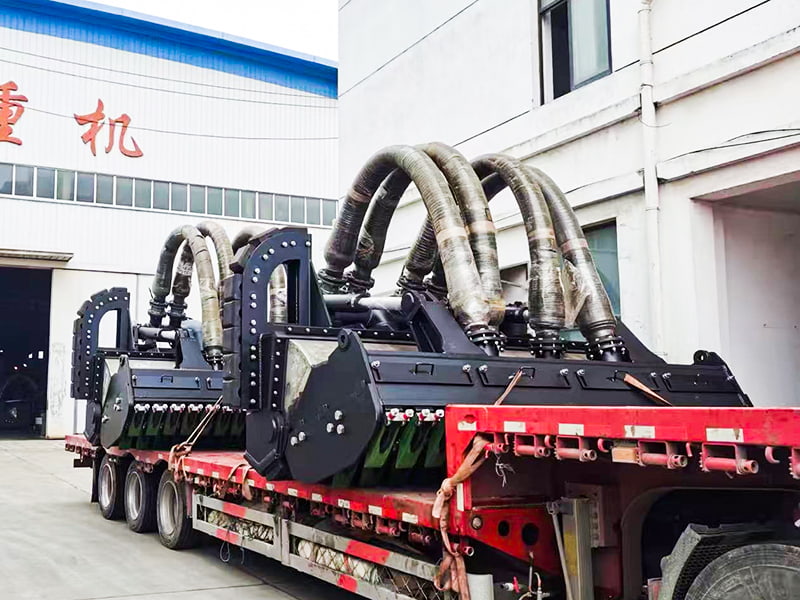 Dredge Draghead Manufacturers, Dredge Drag Head FactoryTaizhou Sanyang Heavy Machinery Co., Ltd is China dredge draghead manufacturers and dredge drag head factory, To cut the seabed, the dred...View Product →
Drag Head Visor vs Plain Suction Drag Head: Key Differences
The table below sums up the operational differences that matter most to marine engineers and dredge masters.
| Aspect | Drag Head Visor | Plain Suction Drag Head |
|---|---|---|
| Mixture control | Adjustable in real time from the bridge | Fixed during a pass; manual adjustment only when stopped |
| Soil types | Mixed sand, clay, dense silt, variable seabed | Uniform fine sand, soft silt, well-characterized borrow areas |
| Production efficiency | Higher when ground conditions change frequently | High in homogeneous loose soil |
| Operator workload | Requires frequent monitoring and adjustment | Lower; set-and-forget operation |
| Wear parts | More moving parts, hinge pins, visor lip, linkage | Fewer moving parts; mainly bottom bars and side plates |
| Maintenance | More inspections and wear checks required | Simpler routine, shorter maintenance windows |
| Initial cost | Higher due to actuation and hinge system | Lower |
| Typical application | Port maintenance, river mouths, mixed sediment loads | Beach nourishment, offshore sand borrow areas |
How Soil Type Drives the Choice
Drag head selection guidance emphasizes that the choice should be based on soil type and density because each drag head type is designed for specific ground conditions. In a dredging field, the ground often changes from loose sand to dense sand or even soft clay within one dredging track. A visor-equipped drag head allows the operator to adjust the water intake to keep the slurry density within the ideal range for the centrifugal pump. Without a visor, the same soil change might cause the pump to run too lean or to overload the suction pipe with coarse material.
On the other hand, if your campaign is carried out in a well-characterized borrow area with uniform grading, the plain suction drag head can be equally productive. The fewer adjustments also reduce the risk of operator errors. Some dredging companies standardize on plain suction drag heads for routine beach nourishment because the crew can focus on the pumping and hopper cycle. For a broader background on the different types of dredging equipment and how drag heads fit into the system, read our guide to dredging equipment.
Production Impact: Where the Visor Earns Its Keep
The production advantage of a visor is most visible in mixed soils. The chart below gives illustrative relative production values for a medium-size TSHD in three soil conditions, with the plain suction drag head in loose sand set as a benchmark of 100. These figures represent typical field observations and are not a guarantee of performance, but they show the trend.
- Drag head visor
- Plain suction drag head
In dense sand and soft clay, the visor configuration keeps production closer to the benchmark, whereas the plain suction drag head loses more output because the fixed opening cannot adapt to the changing material. If you are evaluating the complete suction line, it is also worth reviewing the drag pipe options for TSHDs to ensure the entire flow path is matched to the drag head.
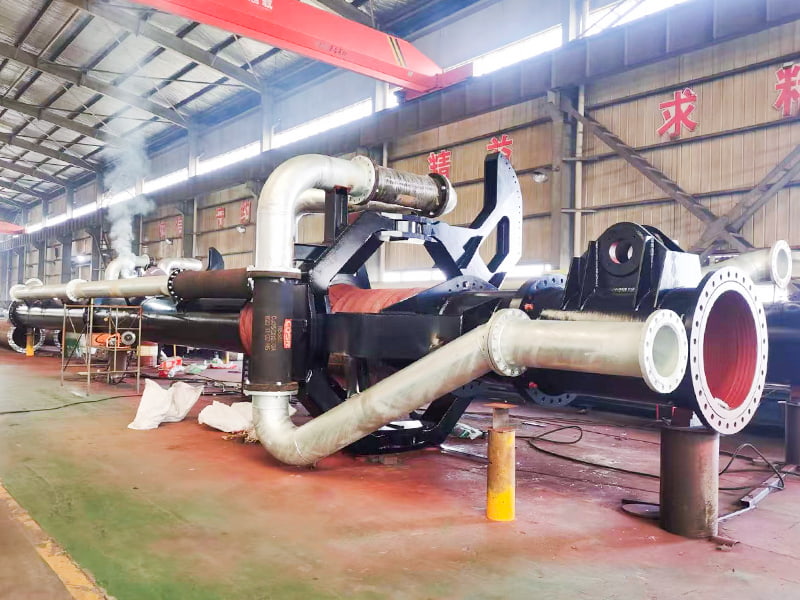 Custom CSD Drag Pipe Manufacturers, China CSD Drag Pipe FactorySanyang Heavy Machinery is China CSD drag pipe manufacturers and CSD drag pipe factory, focuses on the design and manufacturing of non-st...View Product →
Wear, Maintenance, and Total Cost of Operation
The main trade-off of a visor is mechanical complexity. The hinge pins, visor lip, and actuating linkage are exposed to impact and abrasion, so they need regular inspection and replacement. In highly abrasive sand, wear rates on the visor lip can be several times higher than on a fixed plain mouth. A well-planned preventive maintenance schedule is essential to avoid unplanned downtime.
Plain suction drag heads, by contrast, have fewer wear interfaces. The main concern is the bottom wear plate and the protection bars. Many operators choose plain suction drag heads for long campaigns in well-known borrow areas because the maintenance cost is predictable and the head can be rebuilt quickly. However, the cost equation changes when project delays caused by reduced production in variable ground exceed the extra maintenance cost. In that case, a visor drag head pays for itself.
Selection Checklist for TSHD Operators
Use the following checklist to guide your decision between a drag head visor and a plain suction drag head.
- Does your dredging area contain mixed soil types within the same track? If yes, choose a visor.
- Is the project a long-term campaign in uniform fine sand? A plain suction drag head may be more cost-effective.
- Can the crew monitor and adjust the visor in real time? If not, a simpler design might be safer.
- What is your tolerance for maintenance downtime? Visor designs need more frequent wear-part checks.
- Do you need to maximize slurry density to match pump capacity? A visor gives you that control.
- Are you working in areas with debris? The robust fixed opening of a plain suction head may better resist impact.
Frequently Asked Questions
Can a plain suction drag head be upgraded with a visor later?
In most cases, yes. Drag head manufacturers often design the shell and visor carrier so a visor can be retrofitted. However, the cost of retrofit is sometimes close to replacing the head, so it is worth evaluating the expected production gain.
Which drag head is better for clay?
A visor drag head is usually better for clay because the operator can close the visor to increase water flow and help break down the clay, keeping the mixture pumpable. A plain suction drag head often struggles with cohesive clay unless the material is naturally pre-mixed with water.
Does a drag head visor affect pump wear?
Indirectly, yes. By controlling mixture density, the visor can help keep the pump operating near its best efficiency point. That reduces cavitation and abrasive wear caused by overly dense slurry. But the visor itself adds wear parts that must be monitored.
What is the typical price difference?
A visor drag head typically costs 20–40% more than a comparable plain suction drag head, depending on the actuation system and wear parts. Field experience shows the extra cost is often recovered in mixed soil conditions within one major project.
Choosing between a drag head visor and a plain suction drag head ultimately comes down to your soil profile, production targets, and maintenance setup. If your ground is variable, the visor is worth the extra complexity. If your borrow area is uniform and well understood, the plain suction drag head is a proven, cost-efficient choice. For project-specific advice, talk to a manufacturer that builds both configurations and can help you size the right drag head for your dredger.

Copyright 2025 Taizhou Sanyang Heavy Machinery Co., Ltd. All Rights Reserved Professional Dredging Equipment Manufacturer

Back To Top